























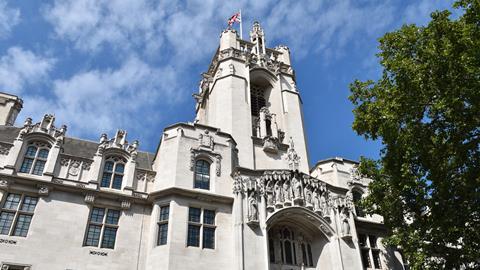
A shipwreck almost a quarter century ago has led to a Supreme Court ruling on the consequences of breaking contractual obligations to arbitrate. In Kingdom of Spain v London Steam-Ship Owners, five justices allowed an appeal by insurers against a judgment by the master of the rolls over the basis on which an insurer can seek recompense from states that were not party to the insurance contract.
The ruling followed extensive litigation over Iberia's worst environmental disaster. In 2002, a Liberian-owned, Bahamas-flagged, oil tanker, the 26-year-old single-hulled MV Prestige, broke in half off the north coast of Spain after the French, Spanish, and Portuguese authorities refused it entry to harbour. It was carrying 77,000 tonnes of heavy fuel oil.
Following the sinking Spain and France brought actions under domestic laws against insurer the London Steam-Ship Owners' Mutual, obtaining judgment in Spain in 2019. This disregarded the fact that the insurance contract contained a clause requiring disputes to be referred to London arbitration under English law. The insurers brought proceedings against each state on the grounds for breaching the clause.
Arbitrators awarded remedies, which the states successfully appealed in the High Court and the Court of Appeal, which ruled that there was no power to award equitable compensation for the breach.
On appeal, the Supreme Court was asked to decide if an arbitral tribunal can award equitable compensation against a state for breach of an equitable obligation to arbitrate and whether the Court of Appeal exceeded the statutory limits of an appeal under the Arbitration Act 1996.
In this week's ruling, Lord Leggatt and Lord Burrows, with whom Lord Lloyd-Jones, Lord Doherty and Lord Snowdon agreed, found the Court of Appeal erred in assuming that the obligation to arbitrate was an equitable rather than a common law obligation. 'The obligation is legal rather than equitable and the appropriate monetary remedy for breach is an award of common law damages,' the judges concluded.
Arbitration specialists welcomed the ruling. 'This is a positive clarification by the court, and further underlines the English court’s support for the arbitral process, including the very limited bases on which the court will interfere with arbitrator decisions and awards,' said Chiraag Shah, partner at international firm Crowell & Moring UK. 'The court’s interpretation of the state’s obligation to arbitrate as being a contractual, rather than an equitable, one under the conditional benefit principle is also a helpful restatement of the law.'
By upholding the arbitrator’s power to award compensation for future consequences the judgment could serve as a deterrent against proceedings outside of the arbitration forum, Shah added.
Thomas de la Mare KC, Christopher Hancock KC, Charlotte Tan and Alexandeer Thomson, instructed by Norwegian-based firm Wikborg Rein, appeared for the appellants; Anna Dilnot KC and Naomi Hart, instructed by international firms Squire Hatton Boggs and K&L Gates, for the respondents.





No comments yet