






















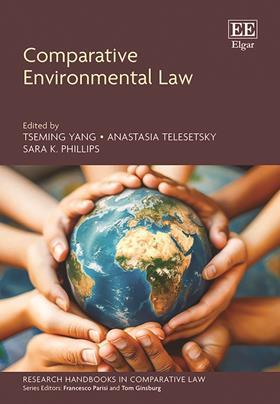
Comparative Environmental Law
Editors: Tseming Yang, Anastasia Telesetsky and Sara K Phillips
£230, Edward Elgar
★★★★✩
This is an ambitious and necessary work at a time when environmental law is confronted with unprecedented global challenges. In the introduction, the idea emerges that comparative environmental law is rapidly evolving, influenced by transnational phenomena such as climate change, biodiversity loss, and the planet’s growing economic and political interdependence.
Drawing on the experience of the three editors – all American lawyers with a history of research and academic work in non-US legal systems – their perspective lends the work particular credibility. Their experience in China, Mongolia, south-east Asia and New Zealand allows them to better grasp the differences, convergences and idiosyncrasies of regulatory systems around the world. Understanding foreign environmental law is now indispensable both for lawyers working in national systems and for those in transnational settings, where environmental disputes and cooperation are frequent.
Each of the book’s five parts is dedicated to a key thematic strand: the foundations of comparative environmental law; environmental governance and sustainability; rights-based approaches; accountability and enforcement mechanisms; and a series of thematic chapters on key sectors such as biodiversity, climate, water, energy and pollution. The methodological variety of the chapters is striking. Some favour global-scale analyses, others narrower comparative studies. There is also a theoretical or pragmatic approach. This heterogeneity is one of the book’s strengths, reflecting the pluralistic nature of this area of law and the diversity of legal traditions from which it draws.
The section dedicated to rights-based approaches – in respect of a healthy environment, indigenous peoples and nature – shows how these strands are reshaping environmental governance. This is evident in countries with constitutional systems open to legal innovation. Civil society is becoming a decisive player in the enforcement of environmental laws.
This study invites reflection on how the law can evolve to address the 21st century’s challenges.
Dr Carlo Corcione is a lawyer and manager specialising in trade, shipping and logistics









No comments yet