






















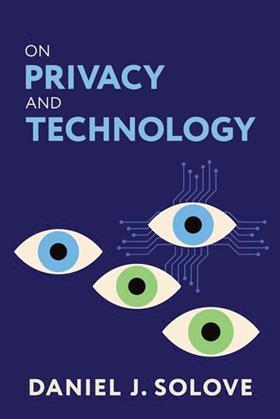
On Privacy and Technology
Daniel J Solove
£16.99, Oxford University Press
★★★★✩
Daniel Solove’s book moves forward like a train. The start is slow, the wheels straining to build up speed. Privacy, as Solove conceives it, is an immense concept, encompassing freedom, self-determination, relationships and power. The ideas in this book gather pace into a powerful testimony for action.
Solove’s introductions and definitions make this book accessible to all. The novice will be acquainted with the basics of privacy law before dipping into thornier issues further on, such as the futility of privacy self-management. By contrast, people with developed opinions will agree or argue with Solove, but in all instances remain curious about where his ideas will lead.
With a kind of careful, incrementalist language, Solove takes readers from answering the basics of ‘What is privacy?’ and ‘What is Technology?’ to explicit calls for individual/consumer-centred regulation.
Some big takeaways for this reader were:
- the onus for privacy protection currently rests unreasonably with the individual;
- the idea of regulation stifling innovation is a myth;
- in judicial decision-making, automated, algorithmic decisions fail to account for the nuances of life, and in so doing, reinforce discrimination (see the use of COMPAS software in US criminal sentencing); and
- if companies can avoid the bare minimum in protecting consumer privacy, they will.
Fortunately, Solove provides some ideas and antidotes for the era in which we live. Laws that are messy and uncertain will work better than those that are simple and clear, because the former require more judgement. Companies would then be required to always worry if they are doing enough. That said, for those advocating for greater privacy protections, ideas are only a starting point, not self-executing. It is up to advocates and individuals to keep pushing for a better, radically reasonable conception of privacy.
We are in the midst of dangerous times. One merely needs to look out of the proverbial window to see violations of women and children by AI tools, fracturing political deepfakes, and the general erosion of legitimacy.
And so – as it is particularly apropos of the present world order – I will end with a quote from the book: ‘One of the most sinister consequences of totalitarian control is creating a culture in which nobody can be trusted.’ Or as Orwell wrote: ‘The Party told you to ignore the evidence of your eyes and ears. It was their final, most essential command.’
Henry Sturm is a licensed US lawyer (non-practising)






No comments yet