






















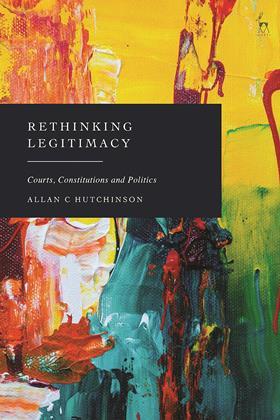
Rethinking Legitimacy: Courts, Constitutions and Politics
Allan C Hutchinson
£90, Hart
★★★✩✩
According to some philosophers, humanity originally lived in a peaceful, equitable, and very dull, state of nature. However, it became necessary for some powerful, neutral authority to exist to determine disputes and protect individuals’ rights. Thus began the ‘social contract’, whereby humans surrendered the state of nature, voluntarily putting themselves under government, limiting their freedoms, but guaranteeing social peace.
While the ‘social contract’ is an origin myth, government by consent permeates democracy. Consent ensures legitimacy. Generally, legislatures and executives can point to markers of legitimacy – usually winning elections. Courts are different; judges are usually appointed rather than elected and cannot easily claim democratic mandates. For courts, legitimacy requires public perception that the judiciary is a valid, trustworthy and authoritative interpreter of the law.
Hutchinson considers the US and Canada, which have arguably more politicised – and in the case of the US, nakedly partisan – judicial appointment processes than the UK. As such, legitimacy seems more pressing in those jurisdictions where rulings on divisive constitutional issues can be seen as partisan courts playing politics.
He argues that courts maintain legitimacy by purporting to base their decisions on neutral principles, while also contending that constitutional adjudication is inherently political. Reviewing cases from each jurisdiction – the US case of Dobbs v Jackson Women’s Health Organization (2021), overturning a previously recognised constitutional right to abortion, and in Canada Re Greenhouse Gas Pollution Pricing Act (2021), where the Supreme Court considered the respective powers of federal and provincial governments – he concludes that both majority and dissenting judges followed political lines. While both presented their judgments as principled and neutral, the approaches and interpretative techniques are so different that the judges were simply putting legal cover on political decisions.
He suggests courts acknowledge the political aspects of judging and says they should explicitly consider political arguments as part of their reasoning. He argues that this would enhance democracy, creating a three-way dialogue between branches of government about the nature of the constitution, and giving the public a greater sense of democratic involvement with the judiciary.
The argument is interesting, the solution utopian. It is hard to see how courts openly embracing politics would improve perceptions of legitimacy. Support for courts, one suspects, would simply fall along partisan lines. It is a bold case, made well; it isn’t compelling.
James E Hurford is a solicitor at the Government Legal Department, London









No comments yet