























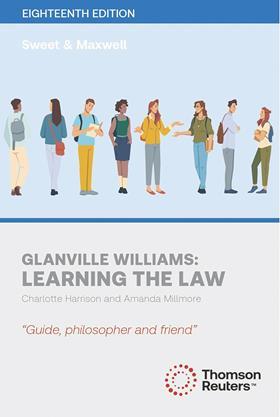
Glanville Williams: Learning the Law (18th edition)
Charlotte Harrison and Amanda Millmore
£14.95, Sweet & Maxwell
★★★★★
I received a copy of this book in the 1970s when I was still at school and wondering if a legal career was for me. That was the ninth edition (1973) and I still have my well-thumbed copy. It was labelled £2, though my brother, who gave it to me, changed it to £12 to make it look more expensive!
I later revisited Learning the Law on a law course at Trent Polytechnic in Nottingham. With a clear introduction to legal history, the sources of law and the structure of the courts, the book was mainly about studying the law and examination technique. It also had career guidance on opportunities, including those in local and national government.
My 1973 edition explained that being a solicitor is ‘not so exacting’ as the bar. The solicitor had clerks and junior partners ‘to do some of the work for him’. (It usually was ‘him’ then.) The average salary for a principal was £5,373, which was more than architects and ‘much more’ than dentists.
Professor Glanville Williams (pictured) was an academic lawyer, best known as the author of many books on criminal law. He was referred to as a ‘radical outsider’, promoting law reform at a time when it was less common. Away from the academic world, he had considerable influence on judges and their decisions.
I do not know how he came to write this book for prospective students. The first edition of Learning the Law was published in 1945; the 18th edition retains the subtitle ‘Guide, Philosopher and Friend’. The first 11 editions were by Glanville Williams; Professor Tony Smith then took over. This volume is written by academics Charlotte Harrison and Amanda Millmore.

This book is useful for any course that has a significant legal element, such as accounting or business. Legal studies, with its arcane terminology and archaic language, can be bewildering to newcomers. New students need to know their way around a law library, and understand how to locate and read law reports. Legal studies can be a bit of a memory test, trying to learn the names of cases and what they mean. Acquiring a comprehensive law dictionary on day one would be good advice.
One strength of my previous edition was the extensive reading list, which is not replicated here. But this edition retains the feel of Glanville Williams’ work. I found it an ideal ‘going away to college’ book.
David Pickup is a partner at Pickup & Scott Solicitors, Aylesbury






No comments yet