






















A Better Way: Making the Family Court the last resort
Stephen Wildblood KC and Dr Freda Gardner
£30, Bath Publishing
★★★★★
Family lawyers will know that, in April 2024, there were significant rule changes intended to promote non-court dispute resolution (NCDR) in relation to children and financial remedy matters. One of this book’s authors, Stephen Wildblood KC, relates that, when he speaks at conferences, he asks delegates who have seen effective use of the Form FM5 to raise their hands. Form FM5 demonstrates the extent to which. He also asks who has experienced a case being adjourned for NCDR to be attempted. Sadly, he finds that, invariably, between 0% and 15% of delegates raise their hands.
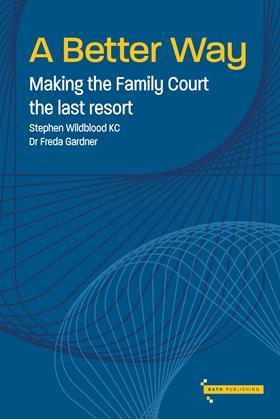
This book is a road map to enable practitioners to avoid the Family Court. Equally, it is a sharp outline of the method of NCDR which the authors offer together. Parties who engage with the advocated offering benefit from working with a consultant psychologist alongside an experienced lawyer and arbitrator in a mediation-style process.
But what of domestic abuse? The dividing line between cases that are suitable for NCDR – despite allegations of abuse – and those that are not is complex. In training, mediators are told that this dividing line is created by the word ‘significant’. Its importance is such that domestic abuse and NCDR has its own chapter.
Throughout the book, the authors explain each of the main forms of NCDR: mediation, arbitration and early neutral evaluation/private financial dispute resolution hearings, and then go on to list their respective advantages and disadvantages.
The duo has formed a business, known as Gardner Wildblood LLP, which provides a service for families covering the full range of family issues, including those relating to children and to family finances and relationships. They say that the model is different to established models of mediation or, indeed, any other form of NCDR. It does not offer legal advice, psychological assessment, or psychological intervention. Rather, Wildblood and Gardner work together with families to help them find an effective alternative to the distress and expense of adversarial family litigation.
One chapter provides details of the approach used in Denmark because it has served as a blueprint for the model which the authors have developed. The Danish model places greater significance on mediation, but there is also a multi-disciplinary approach within the Danish Family Court. In addition to a chapter about this model, written by Danish judge Anni Højmark, family mediation is put in an international context with examples from the Netherlands, Australia and Scandinavia, as well as Massachusetts in the US. The Domestic Relations Court in Delaware County, Ohio, and the Family Court process in Israel are also explored.
The authors also examine parenting coordination, an established form of dispute resolution used widely across the US, Canada and South Africa. The process is intended to help parents experiencing high levels of conflict to implement a final child arrangements order, arbitration award or parenting plan. The parenting coordinator (PC) works with parents to develop co-parenting strategies and to improve communication. If a dispute arises between the parents, the PC will use mediation skills to help them resolve the issue. Ultimately, if a consensus cannot be reached, the PC is authorised by the parents to make a binding decision on the dispute. The Family Law in Partnership Faculty Parenting Coordination Scheme is an example of this.
Having studied the systems of mediation and NCDR in Denmark and other countries, the authors are concerned that the UK system of mediation is too focused on achieving the nuts and bolts of an agreement and not sufficiently on ensuring that the parties remain emotionally intact at the end of the process.
You only engage in surgery where it is necessary and when less invasive treatment is insufficient, say the authors. Like surgery, they add, Family Court litigation involves delay, pain and leaves scars, albeit scars that are emotional. Rather than adopt the court process, Wildblood and Gardner are committed to reducing the emotional impact of separation and to help families avoid litigation if at all possible. Often referring to their work as ‘comprehensive mediation’, they address the issues that can render mediation not possible or unsuccessful. Moreover, the contribution of children has also been vital. Introducing children’s insights and feelings can be a profound catalyst for the process.
With the authors breaking new ground in NCDR, this book is a must-read.
Tony Roe is a family law partner and arbitrator at Dexter Montague LLP, Reading








No comments yet