























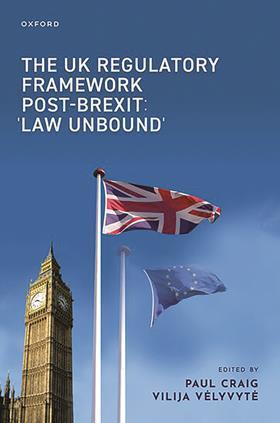
The UK Regulatory Framework Post-Brexit: Law Unbound
Paul Craig and Vilija Velyvyte
£170, Oxford University Press
★★★★✩
The striking words ‘Law Unbound’ in the title, evoking the Greek myth of Prometheus breaking free of his eternal chains and Shelley’s epic poem, are a fitting introduction to this powerful collection of 27 essays. Spanning more than 600 pages, this study by prominent legal academics and practitioners examines the regulatory implications of Brexit for the UK.
A leading theme is the extent (or not) to which the UK and its constituent parts have really broken free of the EU legal system in how they structure their legal affairs post–Brexit. In Chapter 5 (Regulators), Kenneth Armstrong observes that Brexit is often described as ‘a process rather than an event’. But Brexit is much more than that, because in the various sectors the process of breaking free in legal terms has proceeded differently.
All the contributions in this study on the institutional, economic and social ramifications of Brexit are excellent. Elizabeth Fisher (in Chapter 24 on environmental law) writes tellingly about the importance of legal imagination, meaning ‘the mental constructs that lawyers use to think about law’, and which is ‘always in operation because so much of legal thought involves legal speculation’. Brexit, promoted by its supporters as being about ‘taking back control’, has proved much more nuanced in practice, with many areas of EU law being assimilated into UK law, whereas others have been replaced.
As well as considering citizens’ rights and immigration policy, the book focuses on how different sectors of the economy have fared legally since Brexit. There have been radical changes, such as in subsidy control, through the enactment of a new, distinctly UK approach in the Subsidy Control Act 2022. By contrast, the UK’s Competition Act 1998 (reflecting EU law) was left intact. However, when there is much talk of ‘dynamic alignment’ with EU laws (particularly in areas such as the agrifood industry), things could change quickly (or slowly) depending on the prevailing political climate.
The postscript looks at the important Supreme Court ruling in Dillon. Here, the court appeared to have upheld the power of the UK parliament to enact the Northern Ireland Troubles (Legacy and Reconciliation) Act 2023 – notwithstanding possible counterarguments under the UK-EU-inspired Windsor Framework. This reasserted, according to some interpretations, the supremacy of the UK parliament to enact laws. The implications of this decision continue to unfold, but in the context of the UK regulatory framework post-Brexit, this ruling is clearly important.
Each chapter in this masterful study has helpful conclusions. This work is also well–indexed and footnoted, though in the next edition lists of cases and statutes would be welcome.
David Glass is a consultant solicitor at Excello Law









No comments yet