






















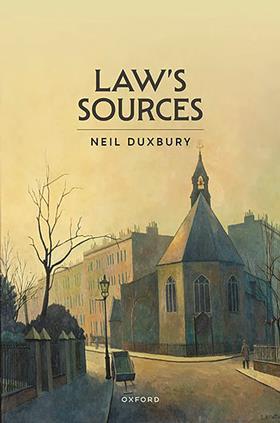
Law’s Sources
Neil Duxbury
£80, Oxford University Press
★★★★★
What are the sources of law? The usual first-year answer is that there are primary sources (legislation and precedent), and there are secondary sources (textbooks, journal articles, obiter dicta).
Only the primary sources bind and are law properly so called; the secondary sources are just there to help with legal research. As a matter of pedagogy, this distinction is fine as far as it goes. But as any litigator knows, in practice the picture is more complicated.
Standard directions and practices, which often have no formal status, are nevertheless of vital practical importance. Similarly, some obvious first principles are set out only in practitioners’ texts, not in precedents. A quote from Chitty on Contracts or Clerk & Lindsell on Torts can sometimes be as authoritative as precedent.
What then is the exact nature of ‘secondary’ sources?
Take still another example – journal articles. Some judges profess to find little assistance from them in general. Others expressly or implicitly adopt reasonings in articles by (some) commentators. Is this just a matter of preference and the inclinations of different individual judges? Or are there deeper principles involved?
Professor Neil Duxbury addresses these questions in Law’s Sources, a culmination of career-long philosophical reflections on the nature of lawyers’ everyday work tools.
His Patterns of American Jurisprudence (1995) covers how US judges and lawyers have understood their own roles and practices in the 19th and 20th centuries. Jurists and Judges (2001) examines the influence of juristic commentary on judicial decision-making, while The Nature and Authority of Precedent (2008), Elements of Legislation (2012) and Intricacies of Dicta and Dissent (2021) are book-length reflections on the doctrine of precedent, statutory interpretation and obiter dicta and dissenting judgments respectively.
The questions Duxbury raises are very different from the issues typically addressed in contemporary philosophy of law courses.
The works of HLA Hart are discussed in Law’s Sources, but Hart (and The Concept of Law) is not treated as the canonical starting point of the discussion. Instead, both Hart and Ronald Dworkin’s work are situated in older and more diverse traditions of judicial and lawyerly self-reflection.
While contemporary philosophers of law tend to talk to each other, Duxbury’s interlocutors are appellate judges and textbook authors past and present, and practical lawyers in general.
For example, the Preface to Law’s Sources acknowledges appraisals and advice from Lord Leggatt, Mr Justice Cranston and Mr Justice Mark Leeming (of the Supreme Court of New South Wales), each of whom also commented favourably on Duxbury’s earlier work.
Like most doctrinal work (but unlike most contemporary academic philosophy of law), Duxbury’s arguments and conclusions are nuanced and not written to advocate for a particular side in a theoretical debate (in the style of Hart versus Dworkin and Finnis on whether law and morality are separate).
Instead, this reviewer would venture to describe Duxbury’s project as a ‘phenomenology’ of law: an introspective account of what judges and textbook writers (and lawyers in general) are doing when they are trying to find out what the law is. The criterion for success is whether lawyers find Duxbury’s account accurate and persuasive, not whether it carries the day in any other academic or theoretical debates.
To take just one example, at p55, Duxbury cites an article by the influential scholar Peter Birks where Birks claims that ‘the self-image of the common law as judge-made is incomplete. It is judge-and-jurist made. The common law is to be found in its library and the law library is nowadays not written only by its judges but also by its jurists’.
Duxbury then subjects this claim to careful analysis in the next few pages: examples cited by Birks to support his conclusions are covered (and distinguished), and similar arguments by other English scholars (in particular Dr Andy Summers) are covered (and debunked). The discussion then widens to US law, where Duxbury addresses parallel US arguments (and foreshadows his later treatment on the related issue of the status of Restatements in US private law). This is just a snapshot of a nuanced and erudite argument that unites the 130-odd pages of Law’s Sources.
Duxbury’s conclusions (stated early on) are conservative rather than radical. While sometimes secondary sources are ‘elevated’, or ‘made to play the role of’, primary sources (and law properly so called), there is a real distinction between primary and secondary sources of law. Stances such as Birks’ (as quoted above) are an overstatement, even if they do reveal nuances hidden under the first-year answer on what the sources of law are.
These conclusions are unsurprising, but like the traveller in Little Gidding, reflective lawyers will enjoy Law’s Sources and find satisfaction when they ‘arrive where [they] started / And know the place for the first time’.
Jasper Wong is a Hong Kong-qualified barrister
Law’s Sources
★★★✩✩
As a legally minded Catholic, my first thoughts on seeing a work about law’s sources turned to St Paul’s moral law, or St Thomas Aquinas’ natural law discoverable by human reason. As it happens, neither the Apostle nor the Angelic Doctor have much to say on this subject, which deals with the more secular issue of the nature of sources.
Primary and secondary sources are broadly defined as sources of actual law, and sources of information and opinion about law, respectively. Duxbury discusses issues such as whether legal norms are always attributable to primary sources, where the line between ‘primary’ and ‘secondary’ is drawn, and how courts deal with sources.

A particularly interesting chapter considers the status of scholarly writings as primary sources, which common law rejects. This contrasts with civil law systems, which often rely on academic writings; Duxbury notes that the origins of civil law systems may have an influence on this. The Corpus Iuris Civilis – Roman law as reformed by Justinian I in the 6th century and received into many European legal systems in the Middle Ages – consisted of a Codex setting out a legal code, supplemented by the Digest and Institutes, which were compiled and edited from the works of various prominent law scholars. All three documents were considered to have the force of law.
The distinction between primary and secondary is more nuanced than it might first appear. Duxbury raises the possibility that some secondary sources may be ‘upgraded’ by court practices, as the UK Supreme Court did in Willers v Joyce No 2. (2016) by allowing judgments of the Privy Council to be considered binding in certain circumstances. He notes that many US jurisdictions have adopted the Restatements – a series of treatises prepared by the American Law Institute seeking to distil and standardise common law principles in various fields of law – as effective primary sources.
This work opened me up to a legal debate I was not aware of.
James E Hurford is a solicitor at the Government Legal Department, London








No comments yet