



















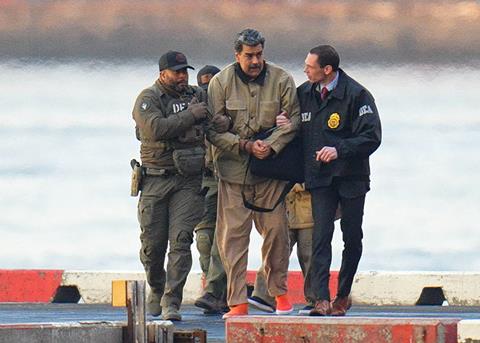
Did the United States break international law when its troops entered Venezuela last weekend and captured the country’s president?

It seems a simple enough question. But it was not one that Yvette Cooper could answer during the foreign secretary’s two-and-a-quarter-hour appearance before MPs on Monday.
The government is committed to international law, she insisted. Ministers supported a rules-based framework, she maintained. ‘Contrary to the great power strategic hemispheres approach, we believe in the transatlantic alliance and the NATO alliance.’ However, it was for the US to establish the legal basis for its actions.
The closest Cooper got to an answer was to confirm the UK’s support for the United Nations charter. As MPs helpfully reminded her, article 2.4 says ‘all members shall refrain in their international relations from the threat or use of force against the territorial integrity or political independence of any state’.
That seems pretty clear. True, chapter 7 of the charter allows the security council to authorise the use of force. But that has not happened here. And article 51 preserves the inherent right of individual or collective self-defence – but only if an ‘armed attack’ occurs against a member state.
The charter is undoubtedly a source of public international law. Indeed, it is hard to think of anything more authoritative than a treaty whose obligations have been accepted by 193 states. So the US will not find it easy to argue that its abduction of Nicolás Maduro complies with the UN charter.
That is why Dame Emily Thornberry, chair of the Commons foreign affairs committee, said we should be ‘calling it out for what it is – a breach of international law’.
But it is fine for a backbencher to say that. Ministers have to maintain diplomatic relations with the US and its president. As Cooper told MPs, ‘we have to engage with the world the way it is’.
It strikes me that there are two ways in which international law can do that. Either we conclude that the US – like other world powers – is in breach and move on. Or we say that international law has moved on in the 80 years since the UN charter was adopted.
That approach would not get us very far in a domestic legal context. Individuals remain bound by acts of parliament until they are repealed. But the sources of international law, as set out in the statute of the International Court of Justice, include international custom and the general principles of law recognised by civilised nations. In other words, it is about what states do.
What president Trump has done is to adopt an expansive view of self-defence. In his view, Maduro was a danger not just to Venezuela but to the US as well. On that basis, the former leader should stand trial for drug smuggling. Given that there was no prospect of getting Venezuela to extradite Maduro, Trump simply did what was necessary to bring him to court. It is just unfortunate that so many of Maduro’s troops were killed in the process.
Attempts to justify US actions led inevitably to an outbreak of whataboutery. ‘Putin and Xi will be using this precedent to strengthen their hands in Ukraine and Taiwan,’ said Sir Ed Davey. But Cooper’s response to MPs who shared the Liberal Democrat leader’s concern was that ‘trying to make an equivalence between the US and Russia is just totally ridiculous and deeply inappropriate’.
I would go further. It is not just that tyrants like Putin need no encouragement to invade and annex other countries. The significance of Trump’s action in Venezuela – and even more so his use of US B-2 bombers last June to destroy underground nuclear sites in Iran – is that it protects law-abiding countries from those who seek to harm them.
As the Wall Street Journal argued in an editorial this week, ‘the demonstration of US nerve and military prowess will do more than a thousand UN resolutions to protect the free world and make Russia, China and Iran think twice’.
All this is very challenging for those who think that the UN, its court and its agencies invariably act in the global interest. Better, they say, that laws should be defied by rogue states than that there should be no laws at all. But that is not how it has to be.
We simply need to inject the notion of morality into international law. States and international courts should act for the betterment of humanity. That may be difficult to define, but we can all understand what it means.
It certainly does not allow Trump to seize Greenland by force. But the world is better off without Maduro in power. As the foreign secretary repeatedly told MPs on Monday, we shed no tears for the end of his rule. The law should recognise that.









10 Readers' comments