























Thinktank calls for action to prevent landmark advisory opinion on carbon emissions landing the UK with climate compensation claims running into the trillions of pounds
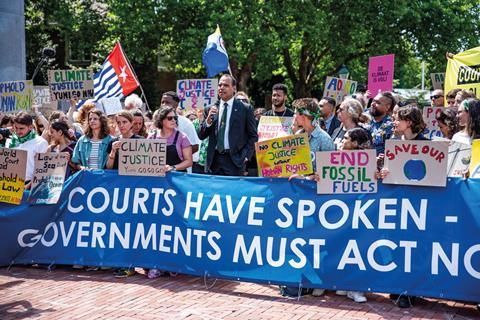
Last month, a group of 10 Australians filed a communication before the United Nations Human Rights Committee asking for a declaration that their country’s support for fossil fuel production violates the International Covenant on Civil and Political Rights. Among other remedies, the complainants in Poelina et al v Australia are seeking a recommendation that Australia implement a plan to phase out coal and gas exports.
Whether the claim gets anywhere remains to be seen. But it could be a harbinger of things to come.
The Poelina claim draws extensively on last year’s landmark advisory opinion from the International Court of Justice on liability for carbon emissions. It invokes the UN court’s treatment of climate change as a global, cumulative, and transboundary problem for which states can be held responsible across generations.
The ICJ opinion originated in a 2023 request by the UN General Assembly following lobbying by Vanuatu, an island nation whose very existence is threatened by rising sea levels. It concluded that there is a duty under customary environmental law to ensure the protection of the environment from anthropogenic greenhouse gas omissions, and that a breach of these obligations constitutes an internationally wrongful act, for which remedies can include cessation, non-repetition and reparations.
Environmental campaigners hailed the opinion as ‘a new era of climate accountability at a global level’. Danilo Garrido, legal counsel at Greenpeace International, said: ‘This will open the door for new cases, and hopefully bring justice to those who, despite having contributed the least to climate change, are already suffering its most severe consequences.’
Enthusiasm is not universal. Thinktank Policy Exchange, known as a longstanding critic of judicial activism (and for its opacity of funding), last week warned that the opinion could open the way to claims for compensation running into trillions of pounds against the UK alone.
In its report Litigating Climate Change, it describes the opinion as the latest venture into politically driven decision-making by the ICJ, which celebrates its 80th anniversary this year. Examples include the 1996 opinion on nuclear weapons and, more notorious in the UK, the 2019 opinion on the Chagos Islands.
While the Policy Exchange authors concede that the ICJ opinion is not binding and quote the court’s own affirmation that determinations of responsibility must be assessed on a ‘case-by-case basis’, they argue this is no reason for complacency.
As the opinion gains traction across national jurisdictions, they say, states and activist groups will invoke it to bring suits against the UK in international forums such as the International Tribunal for the Law of the Sea. Other possible avenues for remedy include international trade, investment and humanitarian laws.
Particularly concerning for the UK is the idea that climate obligations should be guided by ‘intergenerational equity’. Defendant number one would be the UK, as the birthplace of the Industrial Revolution. A bill of £4.24tn is at the lower end of potential liability estimates.
As for any claims themselves, they would involve factual and legal questions of ‘vexing complexity’. One difficulty would be demonstrating the causal connection between emissions at a given time and later injuries.
But even if the prospects of claims are remote, the authors say the UK should take action anyway. Recommendations include withdrawing from the compulsory jurisdiction of the International Court of Justice (the UK is the only member of the UN Security Council to accept compulsory jurisdiction). The UK should make a strong statement affirming that the opinion is not binding and reiterate its position that the 2015 Paris Agreement marks the limits of the UK’s climate change obligations in international law.
Most ambitiously, it recommends renegotiating the 1982 UN Convention on the Law of the Sea – a convention which took decades of painstaking work to create.
These proposed changes are ‘far from parochial. They will maximise the chances for building consensus at home and abroad around real solutions to climate change’.
In a foreword to the Policy Exchange paper, Lord Burnett of Maldon, the former lord chief justice, writes that in its opinion the ICJ ‘appears to have placed the world’s economy under judicial superintendence’. He adds that ‘climate change is a real and urgent problem; so too is the expanding use of the ICJ’s advisory jurisdiction. It is a matter for our politicians to consider whether to protect the UK from its consequences’.
But hopes for – or fears of – action rest on the prospect of a change of attorney general. As we go to press, Lord Hermer (Richard Hermer KC) is very much still in post.
This article is now closed for comment.













5 Readers' comments