






















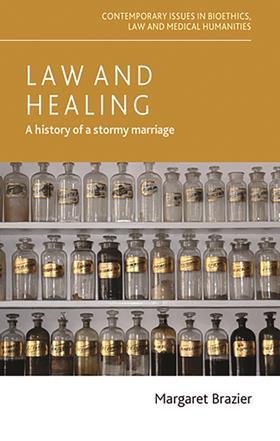
Law and healing: A history of a stormy marriage
Margaret Brazier
£25, Manchester University Press
★★★★★
Medical law is, if we are honest, still a poor relation in doctrinal law. It is often treated as an offshoot of tort, with roots in crime and public law, rather than recognised as a mature discipline. It is testament to Margaret Brazier that she has done much to pioneer the field. This work – originally published in 2023 and now reissued in paperback – was Brazier’s last published work before her death in early 2025.
Brazier poses a question: what benefit is gained from studying history? Indeed. She takes the view – one I share – that studying and attempting to understand history is worthwhile in its own right. She also argues that we can learn from history to address current problems. Societies, institutions, even individuals, are shaped not only by their own history, but by the events and social currents around them. A full appreciation of what came before is essential to truly understand our own day. To dismiss history as irrelevant is a colossal error.
In making her case, Brazier covers plenty of ground. In the meat of the work, she analyses how medical law’s history has informed, and continues to inform, its current shape, arguing that present principles and controversies were already present in embryonic form in earlier times. For the theologically minded, there are parallels with John Henry Newman’s arguments about the whole richness and complexity of Catholic doctrine being contained in, and evolving from, the comparatively unsophisticated teachings of the early church.
Debates around when it is permissible to deliberately end life are there in Lord Coleridge’s judgment in R v Dudley and Stephens [1884], the cannibal seamen case that is well known to first-year law students.
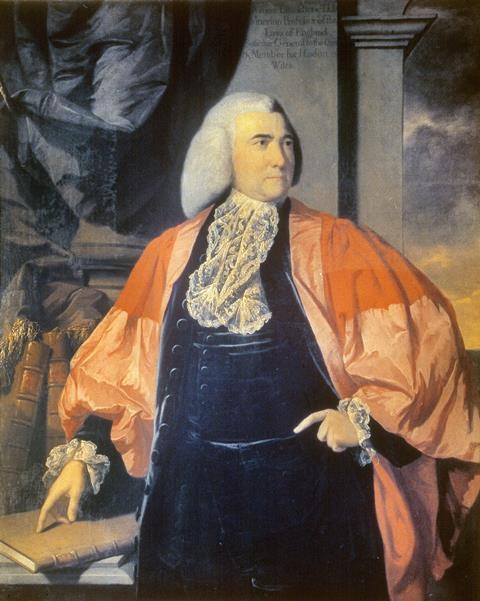
The place of public interest in restricting what a person can do to their body is debated in works by scholars such as Sir Edward Coke (1552-1634) and Sir William Blackstone (1723-1780, pictured). Questions of informed consent, and when a person may consent to having serious harm inflicted on them, hark back to the long-dormant common law offence of ‘maim’ – or ‘mayhem’ – which criminalised conduct causing permanent and disabling injury to another.
Where life begins, or ends, was discussed by Henry de Bracton (c.1210–c.1268). Meanwhile, early litigation over negligent medical treatment – often dealing with matters such as farriers treating injured horses – saw courts taking an approach to determine standards of care that was far less deferential to the medical profession than the Bolam test.
In the contentious zone of professional regulation, too, the debates over how far the state should go in controlling medical practice have a hallowed history. After being largely overseen by the church for centuries, by the 16th century what we think of as medical practice was divided between the three professions of physician, surgeon and apothecary – what Brazier calls the ‘orthodox’ – all of whom jealously guarded their own share of the market.
Parliament largely left the professions to their own devices, giving bodies such as the College of Physicians powers to admit and discipline their own members. A formal system of state regulation was not introduced until the creation of the General Medical Council in 1858. Even then, Brazier argues, the professions’ motivation to consent to regulation was not so much protecting the public – the legislation did not make it illegal for unauthorised people to provide services, only to claim that they were regulated – as preserving the orthodox’s monopoly.
This work is thorough, well-referenced, readable and presents a compelling case. Although more of a quick review rather than an in-depth look, Brazier makes a strong case that, in considering medical law today, we should not ignore its history. As Brazier puts it, de Bracton should not be ignored just because he wrote eight centuries ago.
This is a fitting swansong for an academic who spent much of her career advocating for increased understanding of the relationship between medicine and law.
James E Hurford, solicitor, London









No comments yet