




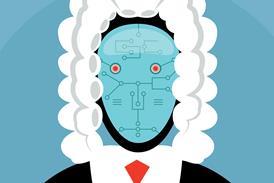
















For six years, I employed a bar school graduate as a legal assistant. This year, I filled the post with AI instead. The graduate I would have hired may be the first barrister victim of this remarkable technology. I wonder, as a clinical negligence barrister, if a similar fate awaits me, with solicitors using AI more and barristers less.

I doubt AI will abolish the need for counsel but it will raise the threshold of instruction. The routine work of barristers will be conducted by solicitors using AI and what reaches the bar will be fewer, more difficult instructions on matters that are complex, high-value or consequential.
In my area, the partial displacement of counsel by technology has already occurred. Fifteen years ago, I was drafting schedules of loss on Word and dreading the fiddly calculations of future loss. How tedious it was to work out the lifetime cost of a new vehicle worth £50,000, purchased every five years over the next 28 years, with a trade-in value of £35,000, and running charges of 30 pence a mile, while giving credit for the car the injured person would have purchased at a cost of £15,000 and a trade-in value of £10,000.
As well as being time-consuming, the calculations required a solid command of facts and figures and the Ogden tables. Today, specialist software does this in a fraction of the time. Solicitors increasingly use this software to draft the schedules themselves, and I am now often instructed to review the schedule before service rather than drafting it. I have been relegated from author to checker. Eventually, when the checks reveal little worth correcting, I may not be used at all.
Recently, I subscribed to a leading legal AI product, which I have found impressive though imperfect. Despite its confident tone, it requires careful checking as it makes occasional mistakes, but I expect it will soon perform various tasks, such as reviewing expert reports, advising on merits and quantum, drafting pleadings and creating agendas for experts, well enough to dispense with counsel. Solicitors will be able to retain work that would otherwise have gone to the bar.
For now, I would like to think that barristers, with their own judicious use of AI, would produce a better result than AI and solicitor alone, but as AI improves the gap will narrow and the marginal improvement may no longer justify the cost of instruction.
For barristers, there will be tougher competition for fewer instructions and those instructions will be for more complex work. Gone will be the easy opinions and simple drafting. The change will also create problems for training, as easy work is how junior barristers cut their teeth. Without it, how will they develop the experience to advise on the difficult cases? Junior solicitors will, I imagine, face a similar conundrum. The profession will need to find a solution to this training problem. I cannot offer one.
As clients will expect solicitors to cut costs by increasing their efficiency with AI, so will solicitors expect savings from barristers. I have already noticed an increase in the speed and accuracy of my work. Legal AI toils alongside me, drafting, checking, researching, and correcting. Barristers who do not adopt AI will struggle to compete against those who do.
Armed with capable AI, solicitors will ask: what can counsel add here? On the written side, which was once my forte, I can see AI catching up behind me, like Usain Bolt in a school parents’ race. Soon, every lawyer will write well.
However, we also bring something no AI currently has, which is first-hand experience of what happens in the courtroom, of how witnesses, experts and judges act and react to questions and submissions. This knowledge and experience informs everything from the initial assessment of a case, to conferences with clients and experts, to settlement negotiations, to trial. There is more to a case than the papers, and this is the part of our work most protected from AI. We have tried-and-tested advocacy skills, judgement forged from experience, and a feel for the courtroom.
Legal AI, my fast-learning friend, has never – to quote Horace Rumpole – stood on his hind legs in court and experienced the thrill of legal battle.
Daniel Sokol is a barrister specialising in clinical negligence at 12 King’s Bench Walk. He is the co-author of A Young Person’s Guide to Law and Justice (2025)









No comments yet