
























The government’s plans to reform local authorities, and the difficulties Mazur has created, were among the hot topics at this year’s Lawyers in Local Government governance conference
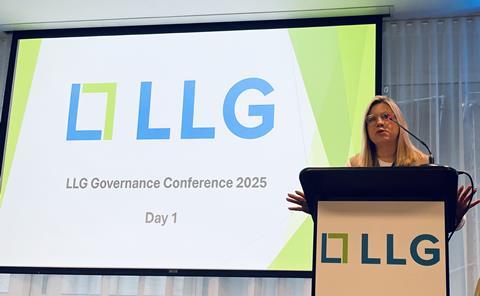
Last month’s Lawyers in Local Government’s governance conference was ‘the biggest one-day conference we have had in a while’, chief executive Deborah Evans declared. The record attendance is perhaps not surprising, given the changes and challenges facing councils across the country.
This time last year, the Westminster government published an ‘English Devolution’ white paper to ‘simplify’ local government, asking all councils in remaining two-tier areas and neighbouring small unitary authorities to set out plans for a joint programme of devolution and local government reorganisation.
Last month, Westminster unveiled plans to reform the standards and conduct framework for local government, to ensure misconduct is dealt with fairly and swiftly. A mandatory code of conduct, including a behaviour code, will be introduced for all types and tiers of local authority.
Hillsborough law
However, one of the opening sessions of the day covered legislation that has yet to come into force but will have far-reaching implications for local authorities, including councillors, officers and their legal teams: the Public Office (Accountability) Bill, also known as ‘Hillsborough Law’.
The bill places a new legal duty on public servants to act truthfully and fully support investigations into the state, ensuring wrongdoing is not concealed. The current misconduct in public office offence will be replaced by tough sanctions, including prison, for those whose actions fall short. Bereaved families will be entitled to non-means-tested legal advice and advocacy at inquests, inquiries and other investigations where the state is involved. Public authorities will have to ensure any spending on legal advice and representation at inquests is necessary and proportionate.
‘This will directly impact how you operate as local authority lawyers and how you and your colleagues manage your work,’ Womble Bond Dickinson’s Siân Ballingall told the conference.
For instance, if someone in the council receives a letter from the coroner, the council will need to volunteer all relevant information, no matter who received the correspondence. ‘We think this is going to require some formalisation of processes to escalate this type of request quite quickly, right up to the monitoring officer and chief executive,’ Ballingall said.
On becoming aware of an inquiry or investigation, lawyers will have to work out its scope and their role. ‘You cannot drag your feet and cherry-pick the information you disclose,’ Ballingall warned.
Private sector contracts might fall under the duty of candour, Womble Bond Dickinson’s Francesca Hodgson predicted. ‘When you look at the number of functions in local authorities exercised by private bodies, it makes a nonsense of the [bill’s objectives] if those parties were allowed some sort of dispensation.’ Councils will need to consider to what extent this duty might need to be considered in procurement processes, she added.
As the new criminal offences ‘up the ante’, Hodgson said lawyers might be asked to clear more statements. They may also need to revisit policies and staff induction training.
On equality of arms, Ballingall said lawyers will need to think about how they resource the local authority’s legal representation. However, one attendee highlighted an insurance-related ramification. When there is an incident, the council must notify their insurer, who may ‘step in’ and dictate the level of legal representation required.
The conference heard that the bill is moving quickly through parliament. It had its second reading in the House of Commons this week and is now with the public bill committee, which will scrutinise the legislation line by line. The committee is expected to report back by 11 December.
Monitoring officers
Monitoring officers – usually solicitors – are crucial to supporting good governance within a council. They are responsible for ensuring that the operation of a council’s decision-making process is lawful and fair. They have a duty to act when it appears to them that any proposal, decision, or omission by the authority has given rise to, is likely to, or would give rise to a contravention of any enactment or rule of law or amounts to maladministration.
However, research carried out by the Local Democracy Research Centre, LLG and law firm Browne Jacobson found that monitoring officers do not feel sufficiently protected to fulfil their governance function without fear of reprisal.
As part of its ongoing efforts to support monitoring officers, LLG revealed at the conference that it has set up the Association of Monitoring Officers to provide them with a ‘safe space’ to grapple with the complexity of their role.
Highlighting the need for a bespoke body, LLG vice-president Helen Bradley recalled experiencing ‘imposter syndrome’ when she was a newly appointed monitoring officer. The LLG network gave Bradley a safe space to speak to colleagues about how she was feeling, share ideas and boost her confidence.
‘When I became LLG national lead for monitoring officers, I established a “phone a friend” service. AMO is taking that one step further with the monitoring officer helpline.’ The helpline will start taking calls in January.
Former LLG president Rachel McKoy will be executive director of AMO. She said AMO will be the ‘professional voice’ for monitoring officers, deputy monitoring officers and aspiring monitoring officers. ‘It’s a tough gig, but it’s really rewarding. We sit at the centre of governance. It’s about ensuring integrity, about difficult conversations, upholding the law, lawful decision-making, working on behalf of our taxpayers.’
Lawyers were asked what they would like the association to do for them over the next 12 months. Responses included practical guidance on matters that regularly arise, raising their profile, ensuring respect for the role, providing a forum to meet other monitoring officers and build links, peer-to-peer coaching, providing local government information on emerging issues, and supporting deputy monitoring officers and succession planning.
Asked how they currently feel about their role as monitoring officer or deputy monitoring officer, and how the job could be improved, respondents said ‘challenging’ and ‘another six hours in the day would be nice’.
Mazur
One of the conference’s closing sessions covered the wider implications of a High Court judgment handed down on 16 September that has sent shockwaves through the profession: Mazur.
Mr Justice Sheldon’s ruling established that unauthorised individuals were not permitted to conduct litigation even under supervision – a finding that rode roughshod over the business models of many law firms, and introduced the risk that legal executives and paralegals have been acting unlawfully for years.
The conference session was entitled, ‘How to structure and run local government services in a compliant way’.
‘What local authorities need to decide is what they are going to do in the face of Mazur’, said Landmark Chambers’ Matthew Reed KC. ‘Mazur does not answer the question people want to know: what is the relationship between the unauthorised individual conducting or carrying out work in a litigation department and the authorised individual? It does not deal with the nature of that relationship.’
One solicitor pointed out that their council employs many people who are not lawyers and do not work in the litigation department, but are engaged in litigation. ‘That’s the problem,’ Reed replied. ‘You need to be authorised to carry out reserved legal activities.’
In light of Mazur, ‘what does that mean for the purpose of a local authority litigation department?’ asked Reed.
'Mazur does not answer the question people want to know: what is the relationship between the unauthorised individual conducting or carrying out work in a litigation department and the authorised individual?'
Matthew Reed KC, Landmark Chambers
Administrative support, such as photocopying, checking documents and filing? All officers. Providing advice and taking steps before litigation? All officers. Conducting litigation, responsibility for drafting proceedings, taking responsibility for service? Authorised persons only. Carrying out drafting, assessing and amending where appropriate, signed and served by authorised persons only.
However, said Reed: ‘I cannot believe it would be right that someone who has drafted a series of documents they have been told by their supervising individual to do, once they have done the drafting, it’s considered carefully by the authorised person, that that would be contrary to the Legal Services Act. Otherwise, it would cause a number of decisions to grind to a halt.’
Mazur has prompted a flurry of questions. For instance, if a local authority itself does not need to be authorised, is it possible that those carrying out reserved legal activities do not need to be authorised? What is the position with regard to CILEX-qualified members? What about their role as managers of unqualified individuals? Can the CILEx regulator authorise appearances in the Court of Protection?
‘Say you have no legal department. The director of children’s services decides she is going to take a child into care. She would be entitled to do that. On this reading of Mazur, she would be liable to prosecution,’ one solicitor hypothesised. ‘The legislation does not adequately deal with local authority departments and the practical reality of dealing with those sorts of cases,’ Reed replied.
CILEX has been granted permission to challenge the Mazur decision in the Court of Appeal. Given the uncertainty and worry Mazur has caused within councils, it was suggested LLG might want to join as an interested party.













No comments yet