























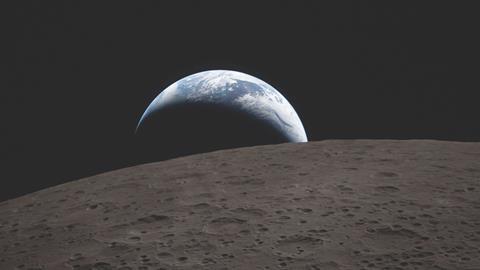

The Artemis II mission has brought back into focus the extraction of space resources for commercial gain. But laws governing the exploitation of lunar materials remain an untenable fudge
Tonight, if all goes well (never take spaceflight re-entry and recovery for granted), NASA’s Artemis II mission will splash down in the Pacific. For all the efforts of its telegenic crew, the flight will have made no great leap in space exploration. Its purpose is to prove the technology for a much longer-term programme: humanity’s return to the moon, not just as a scientific stunt but in order to exploit its resources.
The legal basis for doing so is flimsy: today, nobody owns the moon. But the moment anything of commercial value can be exploited there – starting with water (to electrolyse with solar power into hydrogen and oxygen) – 60 years of diplomatic fudge about the issue will become untenable. So warns philosopher AC Grayling in the latest edition of his polemic Who Owns the Moon?. And when this occurs, history suggests the unconstrained scramble for resources will lead to inevitable conflict. ‘The tragedy as in “the tragedy of the commons” in space will be great,’ he predicts.
In theory, the Artemis programme was established on the basis of an international legal consensus. The 2020 Artemis Accords, agreed by NASA in coordination with the US State Department and seven other initial signatories including the UK, provide a common set of principles to govern the civil exploration and use of lunar resources. In particular, signatories ‘affirm that the extraction of space resources does not inherently constitute national appropriation’ and pledge to conduct such activities in a sensitive manner.
However, there are snags. For a start, the current list of 61 signatories conspicuously omits China, the one nation racing the US to build a lunar base.
More fundamentally, the non-binding Artemis Accords reflect the diplomatic fudges built into the founding charter of international space law – the 1967 Outer Space Treaty. This blend of the hippies’ Age of Aquarius and cold war realpolitik was modelled on the 1959 Antarctic Treaty, which deftly parked the issue of sovereignty. In a similar vein, the 1967 treaty declares that ‘the exploration and use of outer space, including the moon and other celestial bodies, shall be carried out for the benefit and in the interests of all countries’. Article II states that celestial bodies are ‘not subject to national appropriation’.
'The tragedy as in "the tragedy of the commons" in space will be great'
AC Grayling, Who Owns the Moon?
Other clauses explicitly ban the placing of nuclear weapons in space (ignored by designers of nuclear-armed intercontinental ballistic missiles) and promote international cooperation generally, for example by opening facilities to foreign observers and rendering assistance to other nations’ astronauts in distress. The Artemis Accords echo these ideals. Signatories also promise to preserve our outer space heritage, including ‘historically significant sites and artifacts’. However, celestial souvenir hunters should probably be more wary of domestic US legislation – the One Small Step to Protect Human Heritage in Space Act, passed by Congress in 2020.
Elsewhere, growing government interest in the potential of space for economic growth has prompted a surge of legislation in recent years. For example, the UK’s Space Industry Act, dating from 2018, sets a legal framework for spaceflight activities conducted from British soil. (Under the act, you will need a licence to ‘launch, or procure the launch, of a space object’.) Last year, the European Commission unveiled the EU Space Act, which seeks to boost the competitiveness of Europe’s space industry through a common legal framework.
None of this activity clears up the areas fudged in the underlying 1967 treaty. For a start, it does not even define where outer space begins: a crucial issue given the century-old convention that states enjoy sovereignty in the airspace over their territory. Meanwhile, reflecting an age where spaceflight was a government monopoly, the treaty says nothing about the role of private enterprise. Article VII merely asserts that property rights to spacecraft are ‘not affected by their presence in outer space or on a celestial body or by their return to the Earth’. It is tacitly assumed that spacefaring billionaires will remain under the jurisdiction of their home state.
Such deliberate fudges, Grayling suggests, create an ‘expediency timebomb’ - they will hold only until a powerful actor has both the means and the perceived urgent need to ignore them. But perhaps that applies to international law in general. In his History of the Peloponnesian War, Thucydides has an Athenian general telling the neutral Melians: ‘You know as well as we do that right, as the world goes, is only in question between equals in power, while the strong do what they can and the weak suffer what they must.’
This article is now closed for comment.













14 Readers' comments