






















David Lammy today attacked the ‘small-c conservatism’ of lawyers as he vowed to press on with controversial reforms of the criminal justice system.
The lord chancellor also cited in support of his plans the precedent set by Margaret Thatcher. The former Conservative PM had demonstrated ‘that the Crown court, while an important institution, is not an ineluctable one’, he said.
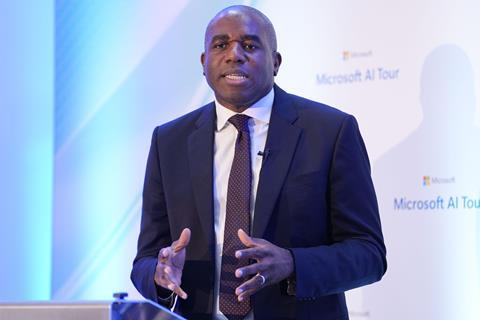
In a setpiece speech at the Excel centre in east London, Lammy confirmed that the government will proceed with legislation to reduce the role of juries in criminal cases. Under plans unveiled in December, new ‘swift courts’, with a judge sitting alone, will handle cases with a likely sentence of three years or less. The judge-only process is estimated to take 20% less time than a jury trial.
In his review of the criminal courts system, Sir Brian Leveson had recommended establishing a new ‘bench division’, in which a judge would be flanked by two magistrates.
‘The reality is that if we do nothing at all, the backlog will rise [from nearly 80,000 now] to over 200,000 cases by 2035,’ said Lammy. ’Even with the investment I’ve announced today, it comes down to 174,000.’
With his package of reforms, Lammy added, the projected backlog falls to about 87,000.
‘This is how we turn the corner, which is my aim by the end of this Parliament, so that we can restore a justice system that delivers for the people that it serves,’ he said.
Asked about opposition to the plans among lawyers, who are planning a day of action over proposed jury curbs, Lammy said: ‘Having qualified as a barrister back in 1995, it can sometimes be a conservative profession with a small “c”. The bar opposed changes to the double jeopardy rule - changes which delivered partial justice for the [Stephen] Lawrence family.
’The Bar Council opposed giving solicitors greater advocacy rights. I think that’s been an important change and I actually want to see more solicitors in particular become judges.’
Read more
Lammy earlier stressed that the Crown court ‘as we know it today’ was not created until 1971. ‘Since Magna Carta, no part of our justice system has stood still. Governments of all stripes have made adjustments in where cases are heard to meet the needs of the time.
’Let us not forget that governments have changed the threshold of crimes going before juries before. Margaret Thatcher reclassified crimes, including taking a motor vehicle without authority [sic] and raising the threshold for criminal damage, so that they’d no longer be subject to juries at all.
’What we’re proposing are changes to that threshold for juries. It does not change the fundamental right to a fair trial, which remains absolute, but there’s no automatic right. And in the current system, only 3% of criminal cases currently go before a jury.’
Lammy also clarified how the government plans to take forward some of the dozens of recommendations to improve efficiency contained in part two of Sir Brian Leveson’s Independent Review of Criminal Courts. Leveson was present to hear his speech.
Lady chief justice Carr will publish a National Listing Framework for cases, ‘ending what many victims justifiably view as a “postcode lottery”’.
From April 2026, so-called 'Blitz courts' in London will focus on assaults on emergency workers to ‘progress and clear older cases that have been waiting years for justice’. Blitz courts list similar cases together over a short period of time, concentrating court resources and seeking to ensure guilty pleas come earlier.
Use of artificial intelligence will be ‘dramatically expanded’ throughout the court system to ‘better support the courts, save time and improve efficiency and transparency’. This includes using AI to transcribe more hearings, including within the Immigration and Asylum Tribunals; to anonymise material across the court system; and to summarise judgments.
HMCTS will also pilot an AI-assisted listing assistant , moving away from pen and paper and introducing digital scheduling as advocated by Leveson.
Case coordinators will be rolled out to all Crown court centres to handle routine tasks that would otherwise be undertaken by judges. Lammy pledged to work with the judiciary to expand the pool of judges eligible to be filmed when passing sentence – ‘increasing transparency and understanding of the court process and ensuring the public can see justice being served’.
There will also be more investment in video infrastructure to expand online hearings in the Crown and magistrates’ courts.
This article is now closed for comment.







33 Readers' comments