



















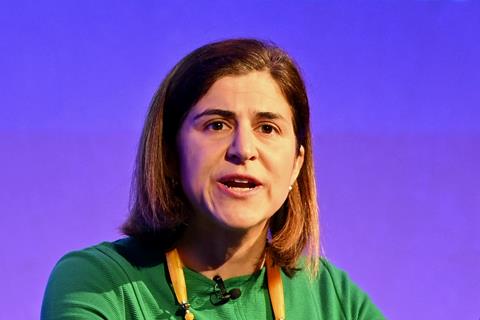
Tackling the Crown court backlog requires ‘nothing short of throwing the kitchen sink at it’, courts minister Sarah Sackman today declared as the government finally unveiled the modelling for its jury trial reforms. The model predicts that the number of outstanding cases will reach 200,000 by 2035 without drastic action.
The projections, which the MoJ says have been independently audited, were released as the justice secretary David Lammy formally announced his reforms to trial by jury. They show that the open caseload in the Crown court - currently hovering around 80,000 - will hit 130,000 by 2030 and over 200,000 by 2035.
Sackman told journalists this morning that the situation was ‘absolutely dire’ and required ‘nothing short of throwing the kitchen sink at it’.
Sackman described jury trial reform as a ‘threshold change’ that would enable the government to ensure jury trials remain available for the most serious offences but more promptly than today. ‘Timeliness is an essential ingredient of fairness,’ she said.
The modelling suggests that even if the Crown court sits at maximum capacity – which Lammy will fund for the 2026-27 financial year – it will not come close to meeting projected demand let alone getting the backlog down.
‘We cannot sit our way out of the crisis,’ Sackman said, noting that 7,500 trials last year were ineffectivepartly due to the lack of a prosecution or defence barrister. ‘It’s not possible for the government to 3D-print judges, prosecutors and defence barristers,’ she said on the workforce challenge.
Read more:
The modelling suggests the government's reform package will reduce demand on Crown court time by a 'conservative estimate' of 20% - the equivalent of 27,000 sitting days. It concluded that:
- Removing a defendant's right to elect for a Crown court trial for all triable either-way offences saves 16,000 sitting days;
- Increasing magistrates' sentencing powers to 18 months saves 8,000 sitting days;
- The new Crown Court Bench Division hearing either-way cases with a sentence of up to three years saves 5,000 days;
- Trial by judge alone for technical and lengthy fraud and financial crime cases saves 200 sitting days;
- Amending the appeals process from the magistrates' court to the Crown court saves 500 days;
- Returning cases to the Crown court for appeal and sentence adds 1,000 days; and
- 'Interactions between the measures' adds 2,500 sitting days.
The government wants to make a 5% efficiency gain by the end of this parliament, Sackman said. ‘We think that's realistic, such is the scale of demand and dysfunction.'
The government expects the bill enabling the reforms to receive royal assent by the end of this year and judges sitting alone to be hearing cases by 2028. Sackman said change of the magnitude the government is proposing will require an 'implementation phase'. For instance, the Common Platform IT system will need to be updated, procedural rule changes will be required along with staff training.
The minister also confirmed that the curbs on jury trials will apply to cases in the current backlog. ‘If we wanted to apply these reforms only to new cases coming into the system, victims would be waiting years to see any improvement in timeliness in the Crown court system. When someone opts for the Crown court, they are opting for a Crown court trial. There's no right to a jury trial under our current system,’ Sackman said.
Asked what she would say to defendants who opted for a Crown court trial thinking their case would be heard by a jury, Sackman said: ‘We're on sound legal ground. There is no right to a jury trial. There's a right to a fair trial.’ She later confirmed, in response to a question from the Gazette, that the government has taken advice from a KC, who has confirmed that there is ‘no procedural or legal impediment’. The government will not reveal who the KC is or publish the KC's advice.
This article is now closed for comment.







12 Readers' comments