



















Eduardo Reyes learned a lot from his unwitting inclusion in a US collective action – and what the experience says about a review of UK competition law on group claims
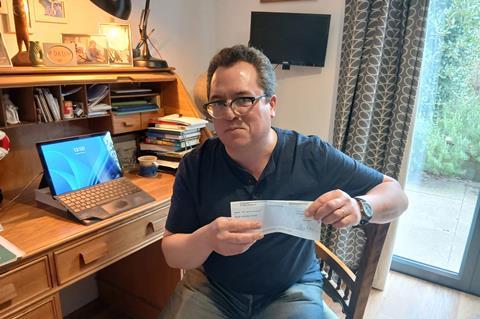
I lock my front door, head to the bus stop at the corner of my road, pat my coat pocket and murmur: ‘Thank you, Trump.’ In my pocket is a cheque for $51. The bus passes along the east side of Peckham Rye, where Boudicca may have fought the Romans, and past The Nag’s Head, drinking haunt in Only Fools and Horses of Del and Rodney Trotter. I alight opposite legendary local shop Khan’s Bargains (everyone around here shops at Khan’s); and with a spring in my step, enter a surviving branch of Barclays Bank.
The arrival of this $51 cheque in my life was a surprise. Addressed to me at my sister’s house, where I have never lived, it was attached to a letter.
‘Hi EDUARDO REYES,’ it began. ‘The enclosed cheque is the result of a settlement reached by President Trump’s Federal Trade Commission (FTC) with Amazon.com Inc. regarding allegations that Amazon violated the Restore Online Shoppers’ Confidence Act in connection with Amazon Prime. Amazon settled the case without admitting liability.
‘You are entitled to receive a settlement payment because Amazon’s records show that (1) between June 23, 2019 and June 23, 2025, you enrolled in Amazon Prime membership through an enrolment method at issue in the FTC’s lawsuit; and (2) you used no more than three Prime benefits in any 12-month period following enrolment. The settlement reached by President Trump’s FTC entitles you to a payment for the Prime membership fees you paid, up to a maximum of $51.’
The FTC’s case boiled down to two main assertions. First, that Amazon signed up customers to a Prime subscription without making it sufficiently clear that this was happening. Second, that the company created practical barriers in the process of cancelling the subscription. And yes, both assertions describe my experience as a customer of the retail giant.
The FTC case was an opt-out class action, and although the FTC is a regulatory enforcement agency, this case closely resembles those instigated by law firms on behalf of a ‘class’. Through making my single Amazon purchase while I was in the US (a present for my nephew), I was to become a litigant without knowing it. When the case settled in September 2025, shortly after a trial began in Seattle, it settled for $2.5bn – a $1bn fine and $1.5bn for consumer redress.
You could think of the $1bn fine as equivalent to the stake a law firm or law firms take in fees in a successful private group claim.
With the case settled in my favour, I arrive at Barclays’ Rye Lane branch clutching the maximum possible payout of $51.
By this measure I am, in the context of this claim, among Jeff Bezos’s biggest victims.
English and patient
From my unwitting involvement in the case, to being addressed with a breezy ‘Hi’ in correspondence, to the fact of my compensation, nothing about my win feels very English.
Yet, as a Gazette feature (‘Competition law: All together now’, tinyurl.com/55j5rx9b) set out, US-style group claims were introduced in the Consumer Rights Act 2015, which allows them in the Competition Appeal Tribunal (CAT). They are here.
Supporters of group claims, such as consumer groups and claimant law firms, and opponents of the regime, are now awaiting the government’s response to a Department for Business & Trade consultation conducted last year – ‘Opt-out collective actions regime review: call for evidence’.
The most prominent opponent of the group action regime is the US Chamber of Commerce, but its negative portrayal of collective actions runs deep in our politics and the media.
'Legal frameworks designed to support justice and accountability are now being repurposed to create a parallel economy where litigation becomes a commercial enterprise'
Sharon Bowles, Lib Dem peer
Traits that are objected to include cost – the proportion of a settlement or award that is taken in legal fees. Where the action is backed by a litigation funder, the return on the funder’s investment can also seem significant. And there is the argument that the regime is anti-business and anti-growth – that a ‘litigation culture’ is a burden on business, not least because of the expense of dealing with unmeritorious claims. Businesses dealing with claims are distracted from growing, and the economy therefore takes a hit.
A highly critical report was published last October by communications consultancy Kendal Global Advisory and US-based legal giant Faegre Drinker Biddle & Reath. This argued that the UK class action regime is ‘simultaneously undermining business investment and failing to deliver fairness for consumers’.
Another such report was penned by Brussels free-market thinktank European Centre for International Political Economy, funded by industry lobby group Fair Civil Justice (itself established by the US Chamber of Commerce). In it, Liberal Democrat peer Sharon Bowles wrote: ‘Legal frameworks designed to support justice and accountability are now being repurposed to create a parallel economy where litigation becomes a commercial enterprise. We must ensure our legal system is a support, not a drag, on the UK’s economic ambition.’

Review timing criticised
The review was a surprise, claimant firm Hausfeld’s global co-chair Anthony Maton tells the Gazette. ‘In theory, we’ve had 10 years of the regime,’ he notes, but points out that because of the time it took the groundbreaking Merricks v Mastercard to reach the Supreme Court, experience of the regime is only five years old. Other claims had been put on hold.
To complicate matters, in December, after DBT’s call for evidence closed, the Supreme Court ‘rewrote the rules’ on the certification of the opt-out claims in Evans v Barclays Bank and Others, Maton notes.
'The feeling is on reading the consultation that there is a desire in government to curtail the regime'
David Gallagher, Geradin Partners
The tenor of the review’s questions pointed towards some departmental sympathy with opponents of the collective claims regime, notes David Gallagher, partner at Geradin Partners, an international firm focused on claims in European jurisdictions. ‘There were several questions that looked weighted against the regime.’
He adds: ‘The feeling is on reading the consultation that there is a desire in government to curtail the regime.’ That includes sections that consider the possibility of strengthening ‘protection’ from liability for businesses.

Cost
‘The UK justice system is very expensive,’ says Gallagher, referencing criticisms of the level of legal costs in successful claims. ‘With the adverse costs regime, you need insurance to cover the risk of losing. There’s the separation between barristers and solicitors, and our love of oral advocacy… very expensive.’
The courts take a proactive role in questioning and controlling costs and deductions from awards and settlements, he notes – including ‘welcome efforts by the courts to limit cost’ through ‘page limits’ on submissions, scrutiny of experts’ fees, and reducing oral hearings.
But, he points out, claimants are ‘up against sophisticated defendants’ who have significant resources.
Gallagher and several of his colleagues share a background in public enforcement, as lawyers at the Competition and Markets Authority (CMA). He argues that, with austerity having hit public enforcement capabilities, the ‘nascent steps’ being taken in private enforcements complement the efforts of public bodies, and thereby support the rule of law and consumer rights.
And he makes the point that even though penalties for anti-competitive behaviour achieved by bodies such as the CMA can be significant, there is ‘very little’ if anything coming back to consumers by way of redress.
There are examples of the state regaining public funds at the CAT. In 2024, a CAT judgment supported the CMA’s 2022 finding that Pfizer and Flynn abused their dominant positions by charging excessive prices for a life-saving epilepsy drug, phenytoin sodium capsules, between 2012 and 2016. The original CAT fines were around £70m. In 2025, the Court of Appeal upheld a CAT judgment supporting the CMA’s £99m fine on Advanz for overcharging the NHS for essential thyroid drug liothyronine.
That was money returned to the public purse, and thereby indirectly supported the NHS. But such an outcome is ‘very rare’, Gallagher notes.
In a case brought on behalf of individual consumers, opt-outs are unusual, he adds. But the perception of group claims as being about a collection of individuals only is wrong. Businesses may compose all or part group. In which case, a claim worth tens of thousands for claimants is less likely to see opt-outs. Where the claim is in the hundreds of thousands, a business may take a proactive view that it could do better by handing its claim to its chosen advisers.
In Kent v Apple, Maton points out, there was not just a consumer side to the case, but also a business side, as app developers were ‘squeezed’ by uncompetitive behaviour. For parliament, Maton notes, the rights of small and medium-sized enterprises were ‘just as important’ when it passed the legislation.
Experience in the US points to a common scenario where a business has an ongoing commercial relationship with the defendant and therefore takes a strategic decision to opt out of the claim. A start-up company, to take another example, may decline to be part of a claim against a large tech company it hopes will buy it.
Who fights?
The process for group claims taken to the CAT is that a firm will file a case. There is then a period before the certification hearing when other firms can seek certification by the court to represent the group.
What follows is a ‘carriage fight’, which may result in one firm being selected, or more than one – the latter a more likely outcome where two cases have been merged by the court. Another possibility is that competing firms and funders come to an agreement on representation, which Maton notes is often the best outcome for class members.
What of criticisms that consumers see little or no benefit from collective actions? In the context of the review, Maton makes the point that only one UK settlement has paid out – one of three boundary fares claims against train operators that settled. Identification of eligible customers for payment was problematic, he notes. Better customer records would attach to other claims, he says, and easier ways would exist to organise the distribution of a settlement.
My claim
Inevitably, I reflect on lessons from my membership of a successful group in a claim. I think the FTC’s proactivity, using the FTC Act and the Restore Online Shoppers’ Confidence Act, is a good thing. Big tech and tech-enabled retailers such as Amazon dominate and permeate our lives at scale. In Amazon’s case, we use one click to shop, yet multiple actions are required to quit your subscription or close your account (which I have now done – and the retailer still makes this process complex, with multiple prompts to not do the deed).
There was clearly a resource deployed to identify me as a victim and also to track me down. That my sister’s address was identified shows some persistence. Such hassle for the defendant should also act as a disincentive to repeating the practices identified in claims.
Regulators who punish a perpetrator, including with fines, but who ignore questions of compensation for consumers like me, undermine consumer rights and the principle of restitution. So this group claim gets a thumbs up from me (though I note the case began when Biden, not Trump, was president – and that the FTC’s focus has bipartisan support).
Now, from cheques that arrived from family in the US for childhood birthdays, I knew mine would attract conversion and negotiation fees, and that a fraction of the $51 would remain for me. No matter. This was a point of principle and an interesting episode.
Only, the smiling Barclays staffer who greeted me broke the news that the bank stopped processing foreign currency cheques as a service six months ago. Back home, I registered online to receive a payment via PayPal, which the claims portal seemed to accept.
That was two weeks ago. To date I have not received a penny. I am though, out of pocket for two £1.75 bus fares – travelling to and from the bank.











No comments yet