



















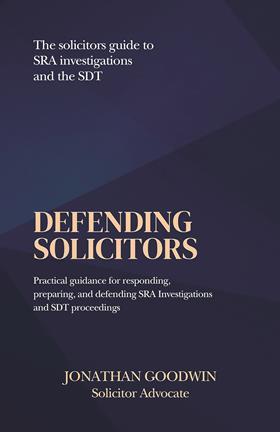
Defending Solicitors: The solicitors guide to SRA investigations and the SDT
Jonathan Goodwin
£17.99, Writing Dr
★★★★★
Those of us who specialise in disciplinary and regulatory law are acutely aware that most solicitors take the view that they will never become embroiled in an investigation by the Solicitors Regulation Authority. Experience tells us, however, that this stance is often over-optimistic.
The SRA’s first approach generally comes in the form of a letter. The reaction of the solicitor recipient is often to reply to it very quickly, without proper thought, and in a state of panic.
Accordingly, when such solicitors seek representation, the damage is already done. The alleged misconduct has been compounded by an ill-advised reply to the SRA.
The author has immense experience in representing solicitors in such circumstances, as well as acting for other professionals.
This concise book is not a textbook on professional misconduct but rather a very welcome practical guide to enable solicitors to deal effectively with regulatory and disciplinary problems. The book’s logical layout starts with that initial contact by the SRA, then charts the investigation process, and deals with the powers vested in the SRA to impose sanctions. The obligation to self-report is clearly explained and the implications of SRA sanctions set out.
The book goes on to discuss cases that reach the Solicitors Disciplinary Tribunal. There is particular focus on allegations of dishonesty in which the almost inevitable consequence is an order for striking off. Such a result, though, is not inevitable. The author cites the case of SRA v Sharma [2010] EWHC 2022 (Admin). I led the author at the hearing before the Administrative Court. This judgment sets out categories of exceptional circumstances which, although not exhaustive, generally provide the applicable parameters. Proper application of this judgment has saved the careers of very many solicitors who have been found to have acted dishonestly. Despite its vintage, this case remains a leading authority in this field.
The author also deals with interventions by the SRA. These effect the closure of a practice and can be catastrophic for the subject solicitors. The possibility of reaching an Agreed Outcome with the SRA is discussed. The positions of various non-solicitors subject to the SRA’s jurisdiction are also addressed.
This book accurately covers all the appropriate ground. I commend it to the profession.
Geoffrey Williams KC is a barrister at Farrar’s Building, London






No comments yet