






















Aged 75, the ECHR faces calls for retirement, while at 25, the Human Rights Act is also under attack. Fiona Scolding KC finds their links to peace, stability, respect and autonomy to be intact. So what now?
The low down
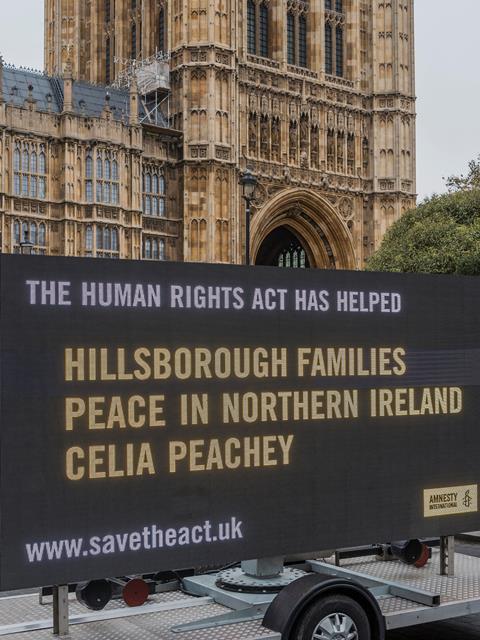
Human rights laws, accessible through the Human Rights Act 1998 (HRA) and backed by the European Convention on Human Rights on which it is based, are under unprecedented attack. UK political leaders are increasingly convinced they can improve on the vision and drafting skills of post-war lawyers. Certainly, the focus of human rights law – an old Atlanticist vision of peace and stability built on respect for every person – is out of step with our politics. Immigration is the touchpaper for the fire lit under human rights laws. But there is no clean break to be made by the UK. The impact of the convention and the HRA is different to that asserted by its critics. And many public scandals have at their root actions that ignored people’s rights. Is it too late to make the case for human rights?
The years following the second world war were a heady time for international agreements that aimed at peace, stability, prosperity and individual rights – achieved from 1948 onwards in the shadow of an increasingly chilly cold war.
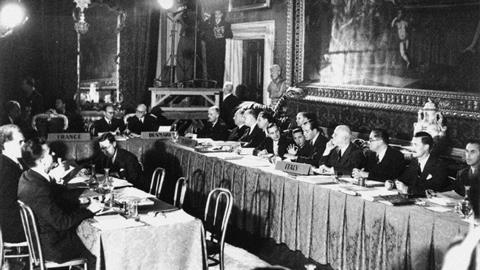
In quick succession came the United Nations Charter (1945), the Universal Declaration of Human Rights (1948), and the foundation of the Council of Europe (1949), which in 1950 created the European Convention on Human Rights. British lawyers played a central role in drafting the convention, ratified by the UK in 1951 and in force from 1953.
The European Court of Human Rights (ECtHR) was established in 1959, and since then, UK citizens have been able to take cases to the court for breaches of the convention. Those rights ‘came home’ in October 2000 when the Human Rights Act 1998 (HRA) came into force, enshrining convention rights in UK law. Around 80% of the current UK population have lived their whole lives with justiciable human rights.
There is little in the actual text of the convention which would present as controversial to a reasonable person. It provides a set of guarantees to life, to prevent torture and slavery and to allow freedom of thought, religious association and the right to marry, along with a right to an effective remedy for such breaches. And because the new Europe of western democracies was being built in response to the recent memory of Hitler and Mussolini, the convention sought to enshrine values of what we in the UK would call a liberal democracy. It says little to nothing about economic and social rights – there is no right to healthcare, housing or benefits. The right to education is only a right not to be denied the education that exists.
And yet, as the convention reaches 75 and the HRA marks the 25th anniversary of its implementation, both are under intense political scrutiny. Questions, once unthinkable, are being asked: can the act survive? Is it a relic of the post-second world war order that has now fallen apart? Has it, as charged, been subject to overzealous judicial activism?
Et tu,Starmer?
'For those of us who use the convention daily, it is particularly important not to dismiss the claims and cries against it as ignorance, as it is telling all of us something about the way that our society perceives itself and the way that our country is (or is not) working'
Even the prime minister, whose book on European Human Rights Law, published in 1999, was on the list of every junior barrister at the time, has publicly identified concerns with how the HRA is applied in cases involving immigration and the need to ‘update’ or ‘refresh’ the convention.
Immigration is the touchpaper which has lit a fire under the convention in the UK and other European countries.
There is and has been concern about the application of the convention to armed conflict (particularly in respect of those who served as soldiers in Iraq and Afghanistan) and acts of the security services. One of the most important human rights cases of the early 1990s concerned the shooting in Gibraltar of members of the IRA by UK security services.
For those of us who use the convention daily, it is particularly important not to dismiss the claims and cries against it as ignorance, as it is telling all of us something about the way that our society perceives itself and the way that our country is (or is not) working.
We must try and debate and give good reasons why the convention matters and why it is important both for our individual lives, but also for the development of peace, stability, respect and autonomy for both the UK community and those in the other 45 member countries.
Calls for reform and exit
Moves are afoot to seek to amend the convention by adding protocols or amendments/derogations in respect of immigration. But, as with any international treaty-making, it is a process which is too lengthy for the average parliament. Impatience has led the convention’s critics to a more radical conclusion: that the UK should leave the convention, a move that would also entail quitting the Council of Europe, for which the convention is a condition of membership.
How easy would it be to either leave the convention or radically change how it is interpreted in the UK?
It is unlikely the current government would pursue a course of leaving the Council of Europe and the convention. It recognises the impact such a move may have upon our standing internationally.
The UK was a founding member of the council and a strong advocate for membership of former Soviet republics after the fall of the Berlin Wall. Departure carries risks for the UK’s wider relationships and would undermine other aspects of international cooperation necessary to fulfil trade and ‘soft power’ aims.
The significance of council membership, though, goes beyond a symbolic commitment to internationalism and considerations of soft power.
The council has developed several international frameworks which the UK government would want to keep. It has developed a Framework Convention on Artificial Intelligence and Human Rights, Democracy and the Rule of Law, which has been signed by both the UK and non-EU states. This is designed to govern the safe use of AI, which in itself engages questions of security. Yet such considerations seem unweighed by Conservative leader Kemi Badenoch (among others), who has pledged to leave the convention if the party wins the next general election.
Supreme Court's role
The HRA has guided important Supreme Court judgments; several in the past year alone illustrate the breadth of issues the HRA regularly assists the court in navigating. One case concerned the teaching of religious education in Northern Irish schools to humanists.
Another determined whether those who were convicted of a crime as teenagers should still have to declare those convictions when they are nearly 60, or whether this is a breach of their rights under Article 8 (the right to a private and family life).
The court considered whether doctors can remain anonymous if they have treated children in high-profile cases concerning the treatment given to those children.
The rights of those charged with a crime, covered by Article 6, were considered in cases before the Special Immigration Appeals Commission for those who are being deprived of their citizenship (in that case, because they had gone to Syria under the influence of their abusive husband).
The highest court has also guided decisions on the proportionality of the sanctioning of Russian individuals who may have close business or other associations with the Russian Federation.
Repealing habits
Parliament could of course repeal or seek to amend the HRA. But the principles of the convention have been part and parcel of decision-making – administrative and judicial – for 25 years. In fact, the principles were influential even before they became part of domestic law.
There would still be a right to take a case to the ECtHR in Strasbourg, though the time this takes means that memories often fade regarding the political controversy of a case.
Even if the act is repealed, government decision-making should take account of and reflect its international treaty commitments (and therefore policy-making would still have to be compatible with the convention).
Section 2 of the HRA provides that a court must take into account ECtHR judgments. That could be removed or diluted. Public authorities could be asked simply to have regard to convention rights or have due regard to them, rather than having to act compatibly with them as section 6 of the HRA currently requires.
Significant steps have been taken in the Immigration Rules to identify that balance in cases involving Article 8 – right to a family life. Those steps weigh heavily in favour of maintaining immigration control and excluding those who have committed criminal offences from the UK, a fact also reflected in numerous appellate authorities.
Crime and the convention
Article 3 of the convention, which bans inhuman and degrading treatment and torture, is often invoked as a source of concern. This stems from the refusal to send those convicted of crimes, who have serious illnesses, back to countries which do not have equivalent healthcare systems or where they may be at risk of torture.
The Court of Appeal and Supreme Court have sought to limit circumstances where those issues would prevent removal from the UK in cases of serious ill health, where a return to the country of origin would lead to death or would precipitate a serious deterioration in someone’s condition.
Some argue that this is not sufficient. They cite various cases involving cats, chicken nuggets or dislike of the heat, but these would appear to be aberrations.
Common law
The HRA has guided important Supreme Court judgments, several in the past year (see box). Undoubtedly, some of these cases would have been determined the same way under the common law. But that is rather beside the point. There is a framework that arguably helps decision-makers to focus upon what matters and also often provides a framework to scrutinise the legality of decision-making by using proportionality.
This would be a significant argument for keeping the HRA. It provides a coherent framework, a legislative text which anyone – including those not legally qualified – can consult to find out what public bodies can or cannot do.
The rights developed are imperfect, focus only on a few areas and allow for sizeable discretion in respect of several matters, particularly the right to privacy and family life, manifestation of religious or philosophical belief, free speech and freedom of assembly. But they are there, and over 25 years have become enmeshed with common law principles. Therefore, even if a new approach were adopted, for example by way of a British Bill of Rights, 75 years’ worth of jurisprudence from Strasbourg and 25 years from UK courts would not be swept aside or immediately ignored.
A side benefit is that very few cases brought against the UK go to Strasbourg – the lowest among all of the council’s member states. Only a couple of hundred applications are made to the European court every year by UK applicants, with most of them not proceeding to a hearing.
Cases where the UK is found in violation of the convention are few, and often amount to only one or two a year. One suspects this is largely because issues concerning violations of the convention are adequately dealt with by the domestic courts. The UK made up around 0.19% of the European court’s caseload in 2023 and the percentage has been similarly low for the past decade.
To suggest that the European court has been intervening in UK decision-making is therefore wide of the mark, given the very small number of cases where violations are found.
Domestic benefits
Various organisations have tried to identify positive cases where the HRA and the convention have helped people outside the realm of immigration. They have largely failed to convince the wider public. Yet there are several obvious examples.
The coronial regime can examine state failures and systemic issues because of Article 2 of the HRA – right to life. It is there for inquests or public inquiries brought against state bodies where people have died or taken their own lives either within mental health institutions or shortly afterwards, or where there have been failures in policing or other state oversight leading to violent deaths.
'Furore about the convention is very rarely actually about the convention. It is an expression of dissatisfaction with political decision-making and policy choices made'
The HRA guides the provision of warning notices to those who the police consider may be at risk of death or serious harm from an abusive partner, stalker or because of criminal activity. These are known as Osman notices after the case which went to Strasbourg.
The right to privacy from unnecessary press intrusion was developing before the HRA, but has been greatly aided by the undertaking of the balancing exercise under Article 8.
There is the provision of freedom of speech to allow for shocking, annoying and irritating speech in the public sphere under Article 10 and to prevent overreach by the police or employers. It allows for more open justice in cases concerning, for example, medical treatment.
The HRA is also a consideration in determining whether it is proportionate to evict those with vulnerabilities from their homes. It provides safeguards for those who live in residential care and lack capacity, by way of an assessment of whether the restrictions on their lives are lawful and proportionate under Article 5.

Wrong target
'These institutions have enabled Europe to be largely conflict- free for the past 80 years... We dismantle this system at our peril'
Furore about the convention is very rarely actually about the convention. It is an expression of dissatisfaction with political decision-making and policy choices. In a world where much is uncertain and anxieties are high, it is tempting to seek to dismantle the post-war consensus as no longer serving our purposes.
I would argue that is a mistake. These institutions have enabled Europe to be largely conflict-free for the past 80 years. They have also, albeit with varying degrees of success, enabled the development of international law. This has proved positive in the evolution of liberal democracy around the world. We dismantle this system at our peril.
Fiona Scolding KC is a barrister at Landmark Chambers, and a contributor to Landmark Chambers’ The Law and Practice








No comments yet