























Our legislation on the division of assets on divorce was forged in the 1970s. With reform on the cards, what should be kept? Catherine Baksi reports
The low down
Government is set on reforming family justice, with a consultation imminent on financial remedies, cohabitation rights and prenuptial agreements. This follows a Labour manifesto commitment to give more rights to the growing number of people ‘cohabiting’ as unmarried couples, and campaigns for wider reforms to make the law more certain and predictable for divorcing couples. But 25 years on from the landmark White v White, which introduced the idea of equality between spouses when matrimonial assets are split, is there an argument for continuing to rely instead on flexible ‘judge-made’ law? After all, 15 years ago, Supreme Court justices in Radmacher v Granatino developed the law by deciding that fairly made prenuptial agreements should generally be enforced.
Martin and Pamela White were married in a period poet Philip Larkin characterised as ‘between the end of the Chatterley ban and the Beatles’ first LP’. Their marriage failed in 1994 and they were divorced in 1997. The subsequent legal dispute over the division of their assets tested legislation passed in 1973, a year when women still needed a man’s signature to secure a mortgage.
It is 25 years since the House of Lords’ groundbreaking ruling in White v White. The seminal family law judgment, from what was then the country’s top court, said that a couple’s joint property should be divided equally on the break-up of their marriage.
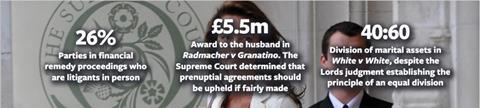
There is irony in the fact that while the judgment benefited many, mostly women, due to some case-specific facts the Lords determined that Pamela White should receive only 40% of the marital assets.
There have been further important developments in family law since then. In 2022, after decades of campaigning, ‘no-fault’ divorce was introduced, with the aim of reducing the institutional acrimony for some couples. But the statute law on financial provision after divorce is still governed by the Matrimonial Causes Act 1973.
Reform calls
Critics argue that the legislation, which was drafted over 50 years ago, is anachronistic. There have been widespread calls over the years for the changes in family structures and society to be reflected in the law governing financial provision after divorce.
Leaving it up to the judges to develop the rules in this area, critics say, has made the law uncertain and unpredictable, making life difficult for litigants and the growing number of couples who, since the removal of legal aid, cannot afford legal advice.
Others suggest that the lack of statutory change has allowed judges the flexibility to decide cases, taking into account changing social norms around relationships and roles of the sexes.
A significant development has been the growing use of prenuptial agreements, the enforceability of which has been shaped by case law, rather than legislation.
It is 15 years since the Supreme Court decided in Radmacher v Granatino [2010] UKSC 42 that prenups should generally be upheld unless they are unfairly made. And it is a decade since the Law Commission published a draft bill on prenups. More recently, just a year ago, the Law Commission published a scoping paper on financial remedies.
Those pressing for change seem to have won the debate – the government is set to publish a consultation on financial remedies, cohabitation rights and prenuptial agreements this spring.
White v White
Martin and Pamela White, then aged 23 and 26, married in 1961 and had three children. Their marriage broke down in 1994 and they were divorced three years later.
Throughout their marriage, they ran a successful dairy farming business in partnership together. At the end of their marriage, their overall net worth was estimated at £4.6m.
Mr Justice Holman, sitting in the Bristol district registry of the High Court, at first instance, awarded Mrs White £980,000 – roughly a fifth of the marital assets – to meet her ‘reasonable’ housing and income needs. The Court of Appeal increased her award to £1.5m – about 40% of the assets after deducting legal costs. Both parties appealed to the House of Lords.
Simon Beccle, a partner at London firm Payne Hicks Beach, was one of the lawyers representing Pamela White in that appeal.
‘The world was a different place,’ Beccle explains. ‘Women were still emerging from centuries of male domination and fighting for gender equality. Traditional gender roles – the male breadwinner and the female homemaker – were changing, but slowly.’
When it came to financial provision on divorce, the law expected a husband to provide for his wife’s reasonable requirements, which, says Beccle, usually left most of the wealth with the husband in non-needs-based cases.
Section 25 of the Matrimonial Causes Act 1973, still in force, sets out the criteria judges must take into account when considering how to divide financial resources on divorce.
In practice, there was an unofficial ‘one-third’ rule, says Beccle. This meant that a wife would likely receive a third of the assets and her husband’s income. Asking a husband to pay more than that, he adds, was thought to act as a disincentive for him to work at all.
The Whites’ marriage, notes Beccle, ‘had been a true partnership of equals’. Mrs White ‘not only had the primary role of looking after the home and bringing up the children, but had also played a very active role in the business partnership, which included milking the cows and paying the farm workers’.
Consequently, she felt that the decisions of both the High Court and the Court of Appeal were discriminatory, unfair and did not properly recognise her full contribution to the marriage. ‘She wanted a fair outcome, which she viewed as 50%, or equality,’ says Beccle.
While the Lords recognised the force of the equality arguments put forward on behalf of Mrs White, which is now reflected in law, it did not apply this to her case and upheld the appeal court’s 40:60 split, says Beccle.
Their lordships, led by Lord Nicholls of Birkenhead, did not divide the assets equally and dismissed both appeals. However, for the first time, the House of Lords said that ‘equality should be departed from only if, and to the extent that, there is a good reason for doing so’.
Nicholls went on to say that ‘there should be no bias in favour of the money-earner and against the homemaker and the child carer’.
The Lords, explains Beccle, ‘recognised that the division of assets on divorce had failed to keep pace with changes in society’. Lord Cooke believed the division in the case would ‘do much to enable English matrimonial property law to meet the requirements of contemporary society’.
The case is feted for achieving equality for women in financial outcomes on divorce. So why did Mrs White only receive 40% of the assets? This, Beccle explains, reflected the fact that Mr White had received a modest inheritance shortly before the parties separated and that his father had lent the couple money to purchase one of the farms at the outset.
‘The House of Lords questioned whether this justified a difference of 20% in the overall shares of the parties, but then did nothing about it,’ he adds.
‘The ultimate irony of the case is that while Mrs White won the equality arguments and changed the law, she was robbed by the House of Lords of the just fruits of her victory.’
She ended up with neither of the two farms co-owned with her husband, but received a lump sum, which her solicitor notes, ‘she then used to purchase a farm’.
Beccle recalls: ‘For years afterwards, Mrs White found it hard to accept that the House of Lords did not apply their judgment in her case to the actual facts of her case and did not give her equality.’
Nevertheless, he suggests that the decision ‘turned English matrimonial finance law on its head and meant that the starting point would be equality. Any departure from an equal division of the fruits of the marital partnership would need to be justified and non-discriminatory’.
A ‘pile of rubbish’?
To improve the experience and outcomes for children and parents involved in private family law proceedings, the government has been piloting a more investigative, problem-solving approach since 2022, in so-called ‘pathfinder’ courts. In the same year, ministers also began to introduce an online portal for applications relating to children. Both initiatives began in Wales.
While the pathfinder roll-out continues, the Gazette has learned that moves to expand use of the portal for cases relating to children has been temporarily halted. National roll-out of the private family law portal was due to happen by the end of March, but the Gazette has been told that ‘functionality’ problems mean its use is currently not supported by the senior judiciary.
A Ministry of Justice spokesperson confirmed ‘HMCTS is working with the judiciary to agree plans to introduce the service nationally, and work continues towards beginning national roll-out later this year.’
Lawyers and court staff have reported ‘design flaws and other more fundamental’ problems. ‘HMCTS is doing what they usually do – instead of proper trialling and piloting, it has got a minimally viable product that it started to roll out,’ says one court worker. The portal is ‘a pile of rubbish – it’s Common Platform 2’, they state, drawing a comparison with the troubled digital case management used in criminal law cases.
Litigants in person face the biggest problems because it is unclear what documents should be uploaded on the system. There is also a lack of support due to the centralised service centre and reduction in court staff, it is claimed.
The portal allows any documents to be submitted. Some litigants use it to continue abuse of former partners by sending obscene pictures and other harassing or intimidating material, the Gazette has been told. Additionally, weeding out irrelevant material sent in via the portal adds to the workload of court staff.
Angela Killa, co-chair of Resolution’s children committee and a solicitor at JCP Solicitors in south-west Wales, has used the portal since its outset. She cites barriers that meant barristers’ names could not be included and difficulties changing the name of the lawyer dealing with the case, but says they have been fixed.
‘It was a bit frustrating as changes didn’t happen as quickly as we would like, but I appreciate there’s a lot of technology going on in the background,’ she adds. Killa uses the portal most days and says: ‘I’m surprised they have stopped the roll-out, as they were starting to get on top of the problems.’
Reform
Case law since then has continued to evolve, but the principles of English matrimonial law remain, at base, those set out more than 50 years ago.
‘There can be little doubt that law reform is desirable to clarify and commit the changes to the statute book,’ argues Nick Manners, also a partner at Payne Hicks Beach. ‘It is quite extraordinary that the law which governs our marriages today was a product of the time of the three-day week.’
As matters stand, Manners says, ‘judges have considerable discretion to interpret the law, which can lead to different judges reaching vastly different conclusions on the same set of facts’.
Changes in society also militate towards law reform, he adds, as many men and women now share the bread-winning and caring roles more equally.
Others, including Baroness Deech, a former family law lecturer, argue that the current law is patronising and paternalistic, assuming that women are incapable of standing on their own two feet. She and family law solicitor Baroness Shackleton (also a partner at Payne Hicks Beach) advocate a system with greater certainty.
Their proposed Divorce (Financial Provision) Bill envisages an assumption of the equal division of marital property, assets and pensions, time-limited maintenance payments for spouses, maintenance for children up to the age of 21 and legally binding prenuptial agreements – similar to the law in Scotland.
Of course, most financial settlements are never adjudicated upon by a court. Some use out-of-court dispute resolution options and other couples resolve matters by themselves, says Manners. But, he argues, the ‘wide discretion in the law’ can make this difficult and result in those wealthy couples who can afford to go to court racking up substantial legal costs.
‘At the other end of the spectrum,’ says Manners, ‘approximately 26% of parties in financial remedy proceedings are litigants in person who have few assets to argue about and have to try to understand and navigate this highly discretionary system.’
The Law Commission has suggested models to change the status quo, which it says ‘lacks certainty and accessibility’. These are codifying the existing law, incorporating particular reforms in relation to prenuptial agreements, maintenance and property division into the law or implementing fixed rules on how assets are to be divided.
Arguing against
Anna Worwood, head of family law at Penningtons Manches Cooper, maintains that the Matrimonial Causes Act 1973 remains good law and that ‘age alone does not equate to obsolescence’.
The 1973 act, she suggests, was ‘drafted with deliberate breadth, empowering judges with discretion rather than prescribing rigid outcomes’. This flexibility ‘has allowed the law to evolve organically through case law, adapting to societal change without constant legislative intervention, and allowed judges to make decisions which are fair for the individuals, based on their specific facts and circumstances rather than a one-size-fits-all formula’.

Cohabitation
Although the government is expected to consult on reforms to clarify the rights of cohabiting couples, together with wider family law reform, some lawyers suggest that change on the former should have been made sooner.
Cohabiting couples are the fastest-growing family type, notes Jo Edwards, a partner at London law firm Forsters, who has long-argued for change in this area. She points to figures showing that the number of cohabiting couples in the UK has grown to comprise 17.7% of families.
‘Yet, despite rapidly changing social norms, there are no rights for unmarried couples in England and Wales,’ laments Edwards, stressing that ‘they are treated as unconnected people’.
If the relationship breaks down, all that is available are possible, limited claims on behalf of a child or difficult-to-pursue claims under trusts and property law, which few have the money to access, says Edwards.
Despite this, she adds, the myth of the ‘common law marriage’ persists and many do not realise they lack rights until it is too late. ‘In my almost 30 years of practice, I have witnessed first-hand the difficulties caused by the lack of rights for unmarried couples and it has worsened over time, as ever more people don’t marry.’
Options, Edwards suggests, include bringing the law in line with the claims available to divorcing couples or allowing for similar financial claims as married people, but with limitations.
However, she stresses that these raise issues that must be dealt with. These include the minimum period of cohabitation required, whether any new law would be retrospectively applied and whether there should be ‘opt in’ or ‘opt out’ provisions.
In Australia, says Edwards, an advertising campaign informing people of similar reform led to many people ending their relationships so as not to be caught by it.
‘Most important when considering reform is that any new law is accessible, clear and ensures that the needs of children are met,’ says Edwards.
While any change can be incremental, she concludes: ‘We need a starting point that protects the vulnerable, and that most couples can work with to reach their own agreements so that the already over-burdened family court isn’t inundated with new cases.’
Catherine Baksi is a freelance journalist








2 Readers' comments