






















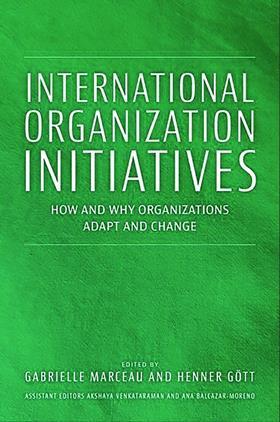
International Organization Initiatives: How and Why Organizations Adapt and Change
Editors: Gabrielle Marceau and Henner Gött
£105.50, Oxford University Press
★★★★✩
This volume examines how international organisations adapt their mandates and practices in response to crises, institutional pressures and evolving expectations among their member states. The authors demonstrate that adaptation occurs through legal reasoning, whether by invoking implied powers, reinterpreting treaty provisions, or constructing new operational practices that draw authority from the organisation’s functional needs.
A further strength of the work is its detailed exploration of the legal role played by international secretariats and their executive heads. It shows that secretariats do not simply implement decisions of member states; they also interpret legal mandates, define operational priorities and, in many instances, initiate new normative agendas. Their actions often serve as catalysts for institutional evolution, raising important questions about the boundaries of delegated authority and the nature of accountability within international organisations.
Another significant theme concerns the relationship between crises and legal innovation. It illustrates how emergencies (that is, financial, health-related, or geopolitical) prompt international organisations to activate dormant treaty mechanisms or develop new procedures for monitoring, implementation and cooperation.
For practitioners, the volume opens fruitful avenues for reconsidering how legal frameworks shape – and are shaped by – the ongoing transformation of global governance. Its central contribution lies in showing that processes of institutional change are not merely political or administrative phenomena but deeply embedded in the legal frameworks that constitute international organisations.
Simone Mamini is a doctoral researcher in law and a visiting lecturer in maritime and international law at City St George’s, University of London
International Organization Initiatives
★★★★✩
The book is a serious academic tract with contributions from lawyers and other professionals who have worked with international organisations (IOs). It focuses on the role of IO secretariats in bringing about change to IOs and their objectives, often in an evolutionary rather than revolutionary way.
Part I concentrates on the theoretical and legal foundations underpinning IO initiatives leading to change and sets the scene for what follows. Parts II and III focus on IO secretariats and their heads.
The real interest perhaps lies in fascinating case studies which illustrate the way that IOs address often tricky and politically sensitive situations. These include:
‘The Establishment of UN Criminal Tribunals: The Role of the UN Secretariat’ (by Huw Llewellyn) and ‘The African Union Commission’s Endeavour with the International Court of Justice for Achieving the Complete Decolonization of Mauritius: The Case of the Chagos Archipelago’ (by Namira Negm).
Part IV deals with the interaction between IOs and the outside world as a catalyst for change. Again, contributions are often in the form of case studies, such as ‘The Global Fund to Fight AIDS, Tuberculosis, and Malaria: Partnerships, Collaborations, and Initiatives with International Organizations’ (by Fady Zeidan and Jean Abboud).
The final chapter pulls together all these themes, arguing that the book ‘has addressed an important gap in the study of IOs and their evolution by pulling back the curtains on the processes behind key initiatives of these institutions’.
David Glass is a consultant solicitor at Excello Law









No comments yet