






















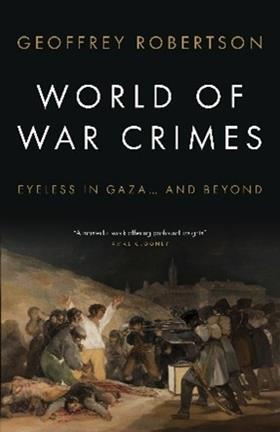
World of War Crimes: eyeless in Gaza and beyond
Geoffrey Robertson
£20, Biteback Publishing
★★★★✩
Geoffrey Robertson’s 17th book could not be more topical. His heart-on-sleeve study of war crimes and efforts to prevent or punish them concludes that the world order set in motion at the end of World War II is no longer viable. Few readers will disagree.
But, apart perhaps from a few months in the late 1940s, was the rules-based order ever up to the job? A run-through of the inconsistencies, loopholes and outright absurdity of war law, suggests not.
‘It was never based on rules, it was based on power,’ Robertson concludes. Why, for example, is it not, in itself, a war crime to drop a nuclear bomb on a city? The short answer is that the states that possess the bomb make the rules. Even the relative success stories of international conventions are riddled with anachronisms. Robertson enjoys pointing out that the Geneva Conventions - at British insistence, apparently - still require preferential treatment for the officer class and lay great stress on the right of PoWs to smoke.
Our veteran campaigning KC of course knows his stuff, but his run-through is not without flaws. It is odd, for example, to depict the atrocities committed by the French authorities in Algeria in 1956 as an example of the ‘supreme crime’ of aggression: at the time, Algeria was legally part of Metropolitan France. Meanwhile a reference to an inquiry into allegations of war crimes by British troops dredged up by a ‘corrupt English lawyer’ appears to confuse Afghanistan and Iraq.
More seriously, Robertson can expect a rough ride over his repeated finding of guilt against Israeli forces in Gaza. In fairness, he chides the International Criminal Court for simultaneously unveiling arrest warrant applications for Hamas and Israeli leaders - because it allows Israel’s supporters to accuse it of implying moral equivalence. No such equivalence exists, he states: 'The Israelis faced different charges, to which they had possible defences, while the Hamas killers did not.’
Not that Robertson has much time for the ‘possible defence’ of collateral damage in pursuit of a military objective. The law should recognise that death from the air 'is not collateral: it is mass murder'. Other ideas in an ambitous blueprint for justice are new crimes of ecocide, bans on autonomous weapons and protection for conscientious objectors, mercenaries and spies.
Who will police this worthy agenda? Obviously the US is out. So, too, is the UN, with most of its members non-democracies under a deadlocked security council. Rather, the book's boldest proposal is for a Churchillian 'union of democracies': European states, the Commonwealth and parliamentary democracies such as Japan which have ratified the Rome statute. 'They could form a powerful coalition', even without the US and independently of the Security Council' with sufficient clout to deter aggression.
While not primarily a military alliance, Robertson says, provision could be made for the use of force against parties committing war crimes. It is an uplifting concept. But whether a coalition of the good could maintain its standards while in an asymmetric conflict with an enemy with a different set of values remains to be seen. As Robertson would be the first to acknowledge, the historical prededents are not good.








No comments yet