






















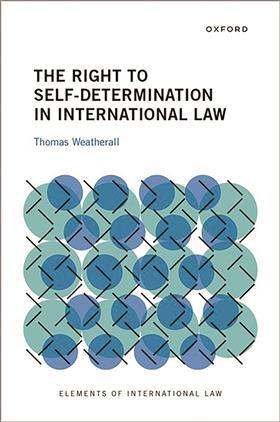
The Right to Self-Determination in International Law
Thomas Weatherall
Oxford University Press, £88
★★★★✩
This book offers a comprehensive and systematic analysis of one of the foundational principles of contemporary international law. The right to self-determination –understood as the right of peoples to freely determine their political status and pursue their economic, social and cultural development – occupies a central place in the international legal order.
The book is structured in three main parts, addressing respectively the sources, content and practice of the right to self-determination. The author charts the historical and normative foundations of the right, then covers its doctrinal interpretation, and finally looks at its application in contemporary practice.
The first part traces the sources of the right to self-determination – from a political principle associated with decolonisation to a legally binding norm embedded in the human rights framework. The author examines the role of the UN Charter, the covenants, and subsequent developments in international jurisprudence and state practice.
The second part explores the content of the right to self-determination, addressing its dual dimension as both an international and domestic legal principle. On the one hand, self-determination functions as a right to independence and guarantees freedom to pursue self-government; on the other, the principle concerns the relationship between a people and its government. The book analyses how these dimensions interact, and how international law seeks to balance the principle of self-determination with other core norms, such as territorial integrity and state sovereignty.
The third part examines the practice of self-determination. There are key examples from international practice and jurisprudence, illustrating the complex and often contested nature of claims to self-determination.
One of the book’s principal strengths lies in its systematic and doctrinal approach. It combines careful legal analysis with a broad examination of international practice.
The book also highlights the continuing tensions inherent in the concept of self-determination. The concept’s application often intersects with competing principles, such as territorial integrity, political stability and state sovereignty.
The discussion of the relationship between self-determination, territorial integrity and state sovereignty is especially relevant for those involved in dispute resolution, diplomatic negotiations or international litigation.
Simone Mamini is a doctoral researcher in law and a visiting lecturer in maritime and international law at City St George’s, University of London









No comments yet