






















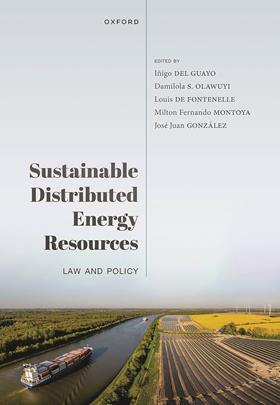
Sustainable Distributed Energy Resources: Law and Policy
Editors: Prof Íñigo del Guayo, Prof Damilola S Olawuyi, Dr Louis de Fontenelle, Prof Milton Fernando Montoya, Prof José Juan González
£130, Oxford University Press
★★★★✩
The accelerating global transition from centralised electricity systems to decentralised and digitally enabled energy networks has generated a growing body of scholarship on distributed energy resources (DERs). Yet comparatively few works have attempted to address the subject through a global, interdisciplinary and sustainability-oriented legal lens. In drawing together perspectives from Africa, Asia, Europe, Australasia and the Americas, this volume offers a timely and ambitious examination of the legal and governance challenges shaping the future of decentralised energy systems.
At the heart of the book is the recognition that the sustainability of future electricity systems will be defined by four interconnected transformations – decarbonisation, decentralisation, digitalisation, and democratisation. These ‘four Ds’ frame a broader inquiry into how law and policy can facilitate a secure, equitable and environmentally sustainable energy transition.
The volume arrives at a critical moment. Globally, governments are investing heavily in renewable energy infrastructure, distributed solar systems, smart grids, battery storage technologies and community-based energy initiatives. At the same time, electricity systems remain burdened by infrastructure deficits, energy insecurity, rising costs and unequal access to energy services. The authors convincingly argue that DERs are not merely technological innovations – they are catalysts for structural transformation.
One of the book’s principal strengths is its refusal to romanticise decentralisation. While DERs are often presented as inherently sustainable and democratic, the contributors demonstrate that their deployment raises complex and sometimes under-explored legal challenges. These include land tenure disputes, unequal access to technology, financing barriers, data governance concerns, consumer protection issues and regulatory fragmentation. Importantly, the book treats sustainability not as a rhetorical aspiration but as a multidimensional legal and policy challenge, requiring careful institutional design.
The chapters dealing with gender justice and human rights are among the most compelling. Rather than treating energy law as a purely technical or economic discipline, the book situates energy governance within broader debates about inclusion, participation and distributive justice. The discussion of decentralised energy communities and cooperative business models is especially valuable in illustrating how energy transitions can empower local communities when supported by enabling legal frameworks.
Importantly, the book does not merely diagnose problems. It offers concrete proposals for improving legal and regulatory frameworks governing DERs.
Simone Mamini is a doctoral researcher in law and a visiting lecturer in maritime and international law at City St George’s, University of London








No comments yet