






















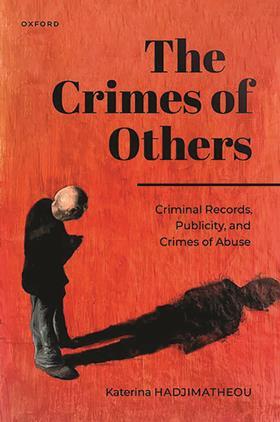
The Crimes of Others: Criminal Records, Publicity, and Crimes of Abuse
Katerina Hadjimatheou
£105, Oxford University Press
★★★★✩
This intriguing work considers the intersection of criminality and the rights of others: does the wider public have a right to know about an individual’s criminal history?
Taking an interdisciplinary approach – political, legal, philosophical – Hadjimatheou produces a compelling justification for providing criminal histories in targeted cases, namely in the case of predatory criminal activity, to allow those who may be harmed to protect themselves.
Why is this a question at all: surely criminals reap what they sow? That misses the point. Having examined justifications for making such information public – breach of the social contract by the perpetrator, or as a right of the general public generated by the wrong done to it – Hadjimatheou concludes that neither is convincing and the question is flipped. Rather than ‘what is the harm to the public that justifies release?’, it is ‘what public interest is served by making information available?’
Stakes are high. The impact for those whose criminal records are revealed to their friends, neighbours and employers can be catastrophic; the ripple effect for their communities limits their ability to ‘flourish’ – to generate fulfilling lives. This has to be set against the risk of harm.
Hadjimatheou concludes that there should be no presumption of publication. Instead, ‘special rights to know’ could be granted to those who look after the interests of the vulnerable, or are directly at risk. Shared on a ‘need-to-know’ basis, this allows protective measures to be taken, particularly where there is a pattern of offending. The scope of disclosure is moveable. The case of Worboys – the black cab driver who drugged and abused women during journeys – is given as an example of widespread disclosure contributing to the public good, prompting more victims to come forward.
There appears to be the odd conflicting statement: variously, it is stated that 20% of the UK population has a criminal conviction, later that a quarter of working-age adults have a criminal record and, later still, a third of working-age adults. This may be reconcilable – perhaps a distinction is being made between adult population and working-age or record versus conviction – but the alarming size of the figure puts the reader on edge. It was also unclear how targeted disclosure might be managed in the age of social media.
This is a well-reasoned work which seeks to tread a fine line between rehabilitation and public protection.
Tom Proverbs-Garbett is director of TrustPoint Governance and author of Being a Trainee Solicitor: How to Survive and Thrive








No comments yet